News analysis ·
Fossil's Profit on Flat Sales: Reading Operating Income
Fossil swung to a quarterly profit while sales rose just 0.4%. We show which income statement lines explain the gap and how to check them.
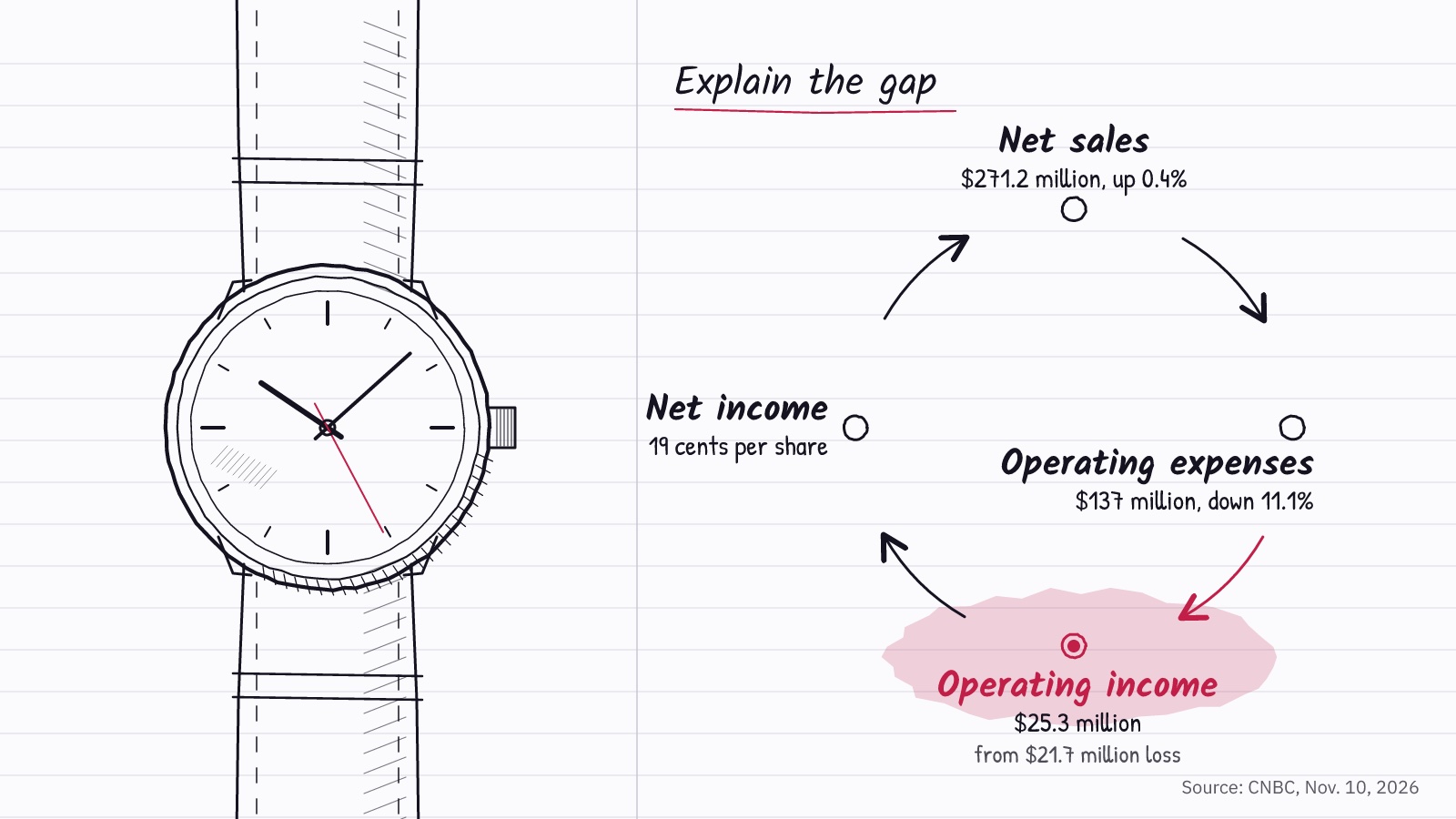
Watchmaker Fossil Group reported a profit for its fiscal third quarter, even though its sales barely moved, CNBC reported. Net sales rose 0.4%, yet the company went from a loss to a profit at both the operating and the bottom line. This article walks through the lines of the income statement that explain that gap, and how you can find them in any earnings report.
The headline in plain words
Fossil released results on Tuesday for the quarter that ended Oct. 3. According to CNBC, net sales were $271.2 million, up 0.4% from a year earlier. That small gain matters to the company because its last year-over-year sales increase came in the first fiscal quarter of 2022.
The bigger change was in profit. A year ago, Fossil posted an operating loss of $21.7 million. This time, it reported operating income of $25.3 million. Net income came to $11.7 million, which works out to 19 cents for each share. In the same quarter last year, Fossil lost $39.9 million, a loss of 76 cents on each share. CNBC noted that the last quarter with net income was the third fiscal quarter of 2022.
The number behind it: operating income
An income statement reads from top to bottom. Revenue, which Fossil calls net sales, sits at the top. It is the money customers paid, minus returns and discounts. Below it come the costs of making the goods and then operating expenses, such as stores, staff, marketing and offices. What is left after those costs is operating income. It shows whether the core business earns money before interest and taxes.
Here is a part that helps explain Fossil's quarter. When sales are nearly flat, profit cannot come from selling much more. It has to come from keeping more of each dollar. According to the company, operating expenses were $137 million, down 11.1%. A cut of that size in the middle of the statement can turn an operating loss into an operating profit even if the top line hardly changes. Better pricing can help too, because selling at full price instead of at a discount leaves more profit on each watch.
Net income is one more step down. It subtracts interest, taxes and other items from operating income. Earnings per share, or EPS, divides net income by the number of shares. That is why Fossil's EPS moved from a loss of 76 cents to a gain of 19 cents. When you compare the two profit lines, a gap between them often points to interest costs, which matters for a company that CNBC says has carried heavy debt.
What the company said
CEO Franco Fogliato, who joined in 2024, told CNBC the plan had not assumed sales growth for roughly another year and a half. He listed the steps behind the turnaround: closing stores, moving from promotions to full-price selling, improving marketing and widening the product range.
Not every line went up. Direct-to-consumer sales fell 5.9%, which Fogliato tied to the company's aggressive downsizing. Asia was the main growth engine, with net sales there up 15.1%, led largely by India. Traditional watches, about 86% of sales, grew 6.4%, while smartwatch sales were under $1 million. On the home market, Fogliato said: "Priority number one is to grow our home market, and we're doing that."
Fossil also raised its full-year outlook. It now guides for net sales of $980 million to $990 million. The earlier guidance called for a decline of between 3% and 5%. Even the new range sits slightly below the just over $1 billion of the prior year, so the raised outlook still describes a small drop. The company also said it expects positive free cash flow by year end. Free cash flow is the cash left after running the business and paying for investments.
Caveats worth keeping in mind
One quarter is a short window. Profit that comes mainly from cost cuts can be harder to repeat than profit from rising sales, because a company can only close so many stores. CNBC also pointed to long-running pressures on the business: competition from smartwatches, heavy debt and falling mall traffic. Compared with their peak in the early-to-mid 2010s, the shares are far lower, and they traded below $8 on Tuesday, even after a recent surge, CNBC reported. A strong report does not tell you where a stock goes next.
How to check this yourself next time
When a headline says a company swung to a profit, you can trace the cause in a few minutes with the income statement in the earnings release.
- Compare the change in revenue with the change in operating income. If profit moved far more than sales, look for the cost line that changed.
- Find operating expenses and see whether they rose or fell, and read the company's explanation, such as store closures or less discounting.
- Step from operating income down to net income and EPS, and note what sits in between, especially interest on debt.
Then read the guidance next to last year's full-year figure. A raised outlook can still point to lower sales than the year before, as Fossil's does.
Sources
- CNBC, 10 Nov 2026
AI-drafted from the filings and reports above, then published automatically after checks that each number appears in a cited source and that no wording is copied. There was no human edit. Educational reading only, not a recommendation on any stock.