Guide
Start here: read a stock page before you buy
Before you buy a first share, learn to read what you are buying. These four steps take a few evenings and use only public, official sources.

Quick answer
Before buying, learn what a share is, read one stock quote line by line, open the company's filings on the SEC's EDGAR system, and check what SIPC does and does not protect [2] [5]. Stocks can lose money.
Key points
- A share of common stock is an ownership interest in a company, and you can lose money you invest in stocks [1] [2].
- A delayed quote can lag by 15 and sometimes 20 minutes, so read the time stamp before the price [7].
- Every 10-K and 10-Q filed with the SEC is public on EDGAR, and the 10-K's Risk Factors section lists the company's most significant risks [4].
- SIPC protection is limited to $500,000, including $250,000 for cash, and does not cover a fall in the value of your investments [5].
On this page
Why read a stock page before you buy?#
Because the page tells you what you are buying, and a tip does not. A share of common stock is an ownership interest, or equity, in a company [1]. Its price can rise or fall, and Investor.gov is direct about the downside: there is no guarantee the company will grow, and you can lose money you invest in stocks [2]. Even large company stocks as a group have lost money in about one out of every three years on average [2].
ChartWise does not tell you what to buy. We have no ratings, no price targets and no paid placements. What we can do is teach you to read the numbers on the page: the quote, the filings and the costs. The four steps below are the order we suggest.
What are the four steps?#
- Learn what a share really is
Start with what a stock is: ownership, votes, dividends that are not required [3], and your place in line if a company fails [1].
- Read one stock page, line by line
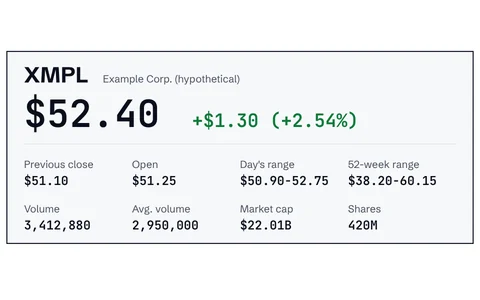
Use how to read a stock quote to go through last price, change, bid and ask, ranges, volume, market cap, P/E and yield.
- Open a real company filing
Follow SEC filings: 10-K, 10-Q and 8-K to find a company on EDGAR and read its Risk Factors and MD&A [4].
- Check the costs and protections
Read SIPC protection explained to see what happens if a brokerage fails, and what is never covered [5].
The table below shows what each step looks at and the one question it answers.
| Step | Where you look | Question it answers |
|---|---|---|
| Step 1: the share | Our explainer on stocks | What do I actually own? |
| Step 2: the quote | Any free stock page | How is it trading right now? |
| Step 3: the filing | SEC EDGAR, public | What does the company itself report? |
| Step 4: the account | Your broker, BrokerCheck, SIPC | What protects me, and what does not? |
EDGAR access [4]; BrokerCheck [6]; SIPC [5].
What should you notice on your first stock page?#
Start with the clock, not the price. A real-time quote shows the most recent bid and offer, while a delayed quote shows the same prices 15 and sometimes 20 minutes after a trade [7]. Then look at the bid and ask. The bid is the highest price a buyer will pay right now, the ask is the lowest price a seller will take, and the gap between them is the spread [8].
That gap matters when you place an order. FINRA notes that brokerage firms typically enter an order as a market order unless you specify otherwise [9], and a market order's price is not guaranteed [10]. Our guide to market orders vs limit orders shows how to control the price you pay.
Why open the company's own filings?#
Because they are the company's own official reports. The annual report on Form 10-K gives a detailed picture of a company's business, the risks it faces, and its operating and financial results for the fiscal year [4]. Quarterly 10-Qs follow the first three fiscal quarters, and all 10-Ks and 10-Qs filed with the SEC are public on EDGAR [4]. Big events in between, such as an acquisition or the departure of a top officer, usually arrive in a Form 8-K within four business days [11].
Two sections are worth reading first. Item 1A, Risk Factors, covers the most significant risks that apply to the company, and Item 7, MD&A, gives management's view of the past year's results [4]. Our company snapshots summarize what a few large companies reported, with every figure taken from their SEC filings.
What does SIPC protect, and what does it not?#
SIPC protects the custody of your account, not the value of your investments. When a member brokerage firm is liquidated, SIPC works to restore customers' securities and cash that were in their accounts [5]. The limit is $500,000, which includes a $250,000 limit for cash [5]. SIPC does not protect against a decline in the value of your securities, or against losses from bad investment advice [5].
Before opening an account, check the firm and any adviser on FINRA's BrokerCheck, a free tool that shows customer disputes, disciplinary events and certain other matters [6].
Mistakes beginners make before a first trade#
- Buying on a tip without opening a filing
Every 10-K and 10-Q filed with the SEC is public on EDGAR [4]. If you have not read the Risk Factors, you do not yet know what can go wrong.
- Trusting a delayed price
A delayed quote can lag by 15 or sometimes 20 minutes [7]. Your order fills at the live market.
- Leaving the order type on its default
Firms typically treat orders as market orders unless you choose otherwise [9]. Check before you submit.
- Thinking SIPC covers market losses
It does not protect against a decline in the value of your securities [5].
- Investing money you cannot afford to lose
You can lose money you invest in stocks [2]. Keep money you need soon somewhere else.
Frequently asked questions#
How much money do I need to start?
Where do I find a company's official reports?
Is my money protected if my broker fails?
If the firm is a SIPC member, SIPC works to restore customers' securities and cash up to $500,000, including $250,000 for cash. It does not cover losses from a fall in value [5].
Does ChartWise recommend stocks?
No. We explain how to read stock pages, filings and costs. We publish no ratings, price targets or buy and sell calls.
The bottom line#
Four steps, in order: understand what a share is, read one quote line by line, open the company's own filings, and know what protects your account and what does not. None of this tells you what to buy, and every stock can lose value. It does mean that when you do decide, you will know what the numbers on the page mean and where they came from. Begin with what a stock is.
Sources
- Glossary (SEC Office of the Advocate for Small Business Capital Formation).
- Stocks - FAQs.
- Stocks.
- How to Read a 10-K/10-Q | Investor.gov.
- What SIPC Protects.
- About BrokerCheck | FINRA.org.
- Real time Definition.
- Bid Price.
- Order Types.
- Understanding Order Types | Investor.gov.
- Investor Bulletin: How to Read an 8-K.
- Fractional Share Investing - Buying a Slice Instead of the Whole Share.
Education only. This page is not investment, tax or legal advice. Stocks can lose value. See our risk disclosure.