News analysis ·
Looser fuel rules and carmaker earnings: what to read
US fuel economy targets were cut and fines scrapped. We show which lines in an automaker's earnings report would reveal the effect, and how to treat EV charges.
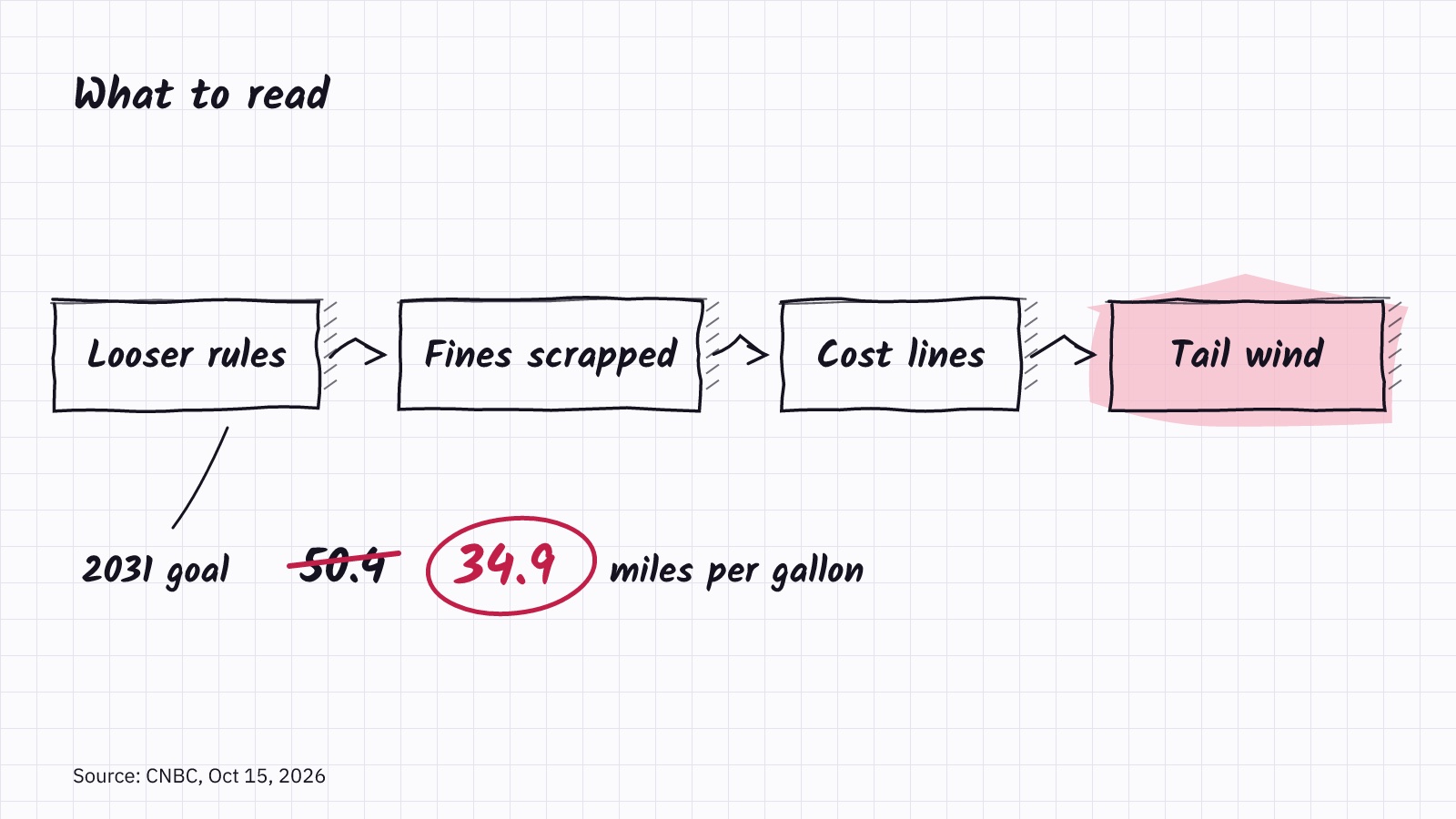
US regulators have sharply lowered fuel economy targets for cars and light trucks, and carmakers no longer face fines for missing them. CNBC reported that one analyst sees this as an earnings tail wind worth a few to several hundred million dollars. This article looks at where that money would actually appear in an automaker's report, and why the huge EV write-downs of the past year need to be read separately.
The rule change in plain words
In late September the National Highway Traffic Safety Administration set a new goal: a fleet average of 34.9 miles per gallon for light-duty vehicles by 2031. Rules finalized by the Biden administration in 2024 had aimed for 50.4 miles per gallon on that 2031 timeline.
Two other changes matter for the numbers. Congress voted last year to remove the fines for missing the standards. According to CNBC, which cited Reuters, GM and Stellantis once paid civil penalties of hundreds of millions of dollars. The new rules also end the market for compliance credits, the permits that carmakers short of the target could buy from makers of cleaner vehicles.
The number behind it: costs, not sales
When an analyst calls something an earnings tail wind, it means a force that pushes profit up without any extra effort from the company. Here the push comes mainly from the cost side. Fines and purchased credits are expenses. If they shrink, more of each dollar of revenue survives down to operating income and, after interest and tax, to net income.
TD Cowen analyst Itay Michaeli told CNBC that lower fine and credit costs have already shown up this year as incremental tail winds. On the size, he said: "And it could be a few to several hundred million dollars." For a large carmaker, that may be hard to spot in one quarter.
The same rule has a second side. Compliance credits were a source of revenue for EV makers such as Tesla and Rivian. For a seller of credits, the change shows up in the revenue line, not the cost line. One rule can lift profit at one company and remove revenue at another.
Why the big write-downs are a different kind of number
The past year also brought very large charges. Ford booked a special charge of $19.5 billion in December, tied to restructuring and scaling back EV investment. GM recorded a fourth-quarter impact of $7.1 billion linked to its EV pullback and restructuring in China. EV write-downs cut Porsche's operating profit in its automotive business by 98% in 2025, and at Honda, write-downs helped produce the first yearly loss the company had posted in about 70 years.
A write-down means a company admits an asset, such as a factory or a product program, is worth less than the value on its books, and it takes the difference as an expense. These charges are usually one-off. Companies often show them separately and also report an adjusted profit that leaves them out. That is why reported net income can fall sharply in a quarter while adjusted earnings look steady.
The reading lesson: the fuel rule tail wind is a recurring change to everyday costs, while the write-downs are a one-time hit. Mixing them gives a wrong picture of the business.
What analysts said about the next steps
Michaeli described a shift in three parts: building fewer slow-selling compliance cars and more combustion vehicles, selling more high-margin models with bigger engines, and moving research spending toward projects that lift profit. Carmakers are already moving. Ram, a Stellantis brand, has restored V-8 engines on its full-size pickups. GM said in September a new small-block V-8 is coming to its Silverado and Sierra trucks. Ford has widened V-8 availability on the F-150, which CNBC describes as the best-selling vehicle in the U.S.
If that mix shift happens, it would show up in margin, the share of revenue kept as profit, rather than only in units sold. Auto analyst John Murphy cautioned that carmakers may need much larger cash balances because the future of powertrains, the costliest part of a vehicle, is so uncertain. He forecasts hybrids rising from 14% of the U.S. market last year to about 34% by the end of the decade. Michaeli still expects EV growth, pointing to high owner loyalty and many two-car households. Roughly 300 million vehicles are on U.S. roads, and the Alliance for Automotive Innovation counts only about 7.5 million of them as EVs.
How to check this yourself next time
When a policy change is said to help or hurt a company's earnings, you can trace it in the filings yourself.
- Find the line it touches: look in the income statement and the notes for regulatory credit revenue, penalties or compliance costs, and compare them with the same quarter a year earlier.
- Separate one-off items: check whether the company lists special charges or write-downs, and read both the reported and the adjusted profit figures.
- Watch margin, not just volume: compare operating margin over several quarters to see whether a richer mix of trucks and engines is lifting profit per dollar of sales.
None of these steps says whether a share is worth buying. They show which number the headline is about, and how big the change is.
Sources
- CNBC, 15 Oct 2026
AI-drafted from the filings and reports above, then published automatically after checks that each number appears in a cited source and that no wording is copied. There was no human edit. Educational reading only, not a recommendation on any stock.