News analysis ·
American Airlines' record revenue and a wider loss
American Airlines posted record quarterly revenue but cut its 2026 outlook to a bigger loss. Here is how to read the revenue, cost and EPS lines.
American Airlines reported its third-quarter results on Thursday and told investors to expect a bigger loss for 2026 than it had said in July, according to CNBC. The same report showed record quarterly revenue. This article looks at how both things can be true at once, and which lines in an earnings release explain the gap.
Record sales, deeper red ink
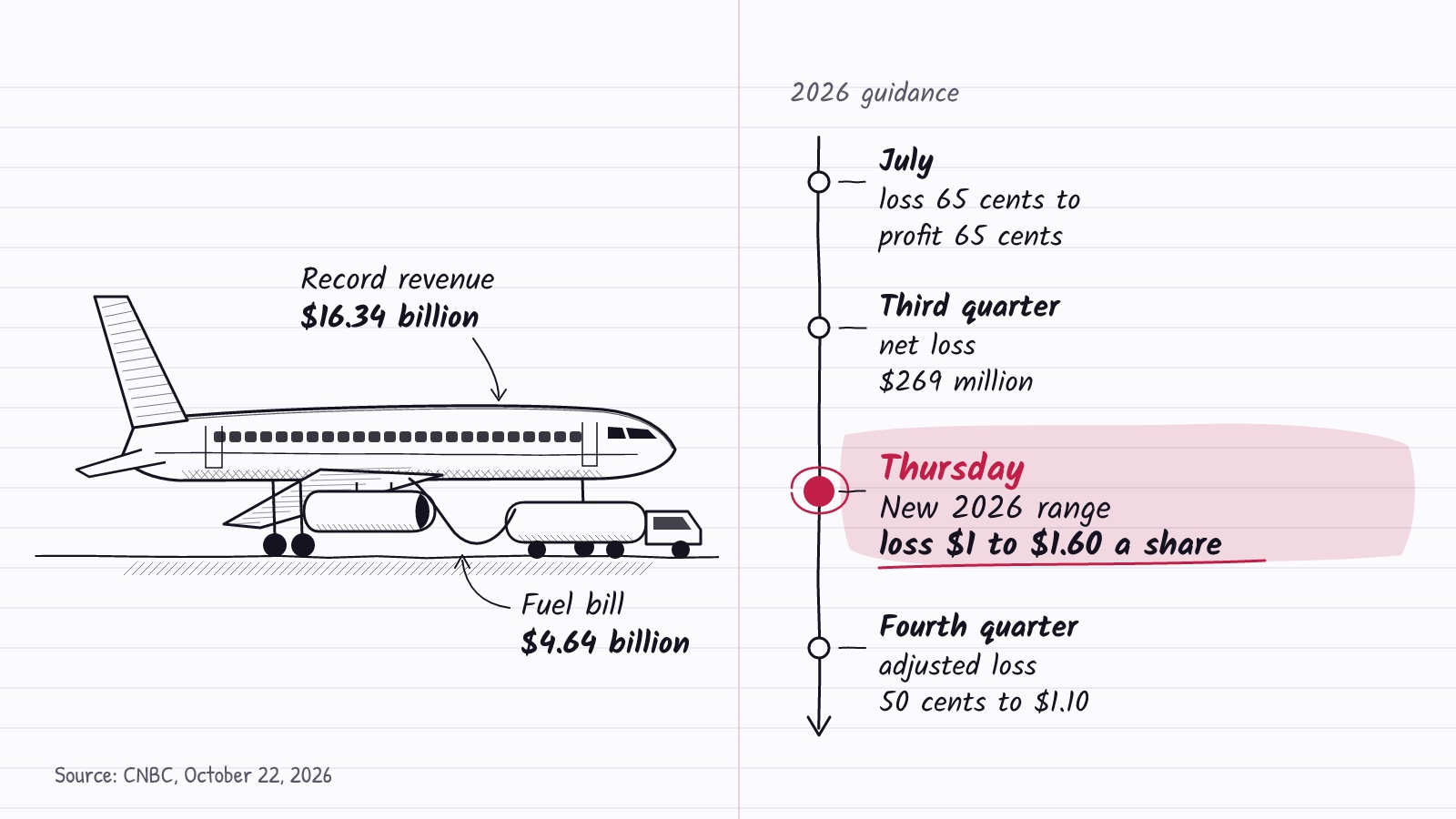
Revenue is the money a company takes in before it pays any bills. For American, that top line reached $16.34 billion in the third quarter, a gain of 19.3% on the same quarter last year. Chief executive Robert Isom described it this way, as quoted by CNBC: "American delivered record third-quarter revenue and the strongest year-over-year revenue growth in my career, with premium performance leading the way."
Yet the bottom line went the other way. Net loss for the quarter was $269 million, or 41 cents a share. A year earlier the loss was $114 million, or 17 cents a share. So sales grew strongly while the loss widened. The reason sits in the middle of the income statement, between revenue and profit.
The number behind it: costs, and fuel in particular
An airline's profit is what is left after its costs are subtracted from revenue. When one large cost grows faster than sales, profit shrinks even in a record quarter. That is what happened here. CNBC reported that American's fuel bill climbed 67.5% from a year earlier to $4.64 billion in the quarter.
Fuel matters because of its size. According to CNBC, jet fuel is the biggest airline expense after labor. Prices jumped after the start of the Iran war. CNBC also reported that airfares are up more than 20% from last year, based on airline reports and federal data.
The lesson for readers: a revenue record tells you about demand, not about profit. To judge profit, compare the growth rate of revenue with the growth rate of the largest cost lines. When a cost line grows several times faster than revenue, as fuel did here, a wider loss is the arithmetic result, not a surprise.
Two loss figures: net loss and adjusted loss
The release gives two per-share numbers for the same quarter. The net loss of 41 cents a share follows standard accounting rules, the figure shown on the income statement. The adjusted loss of 28 cents a share leaves out items the company treats as one-time.
Neither figure is wrong; they answer different questions. When you see an adjusted number, look for the list of excluded items in the release and ask whether they really are unusual. Companies' guidance, including American's, is usually given on the adjusted basis, so that is the line to compare with forecasts.
Reading the guidance change
Guidance is a company's own forecast. In July, American expected adjusted earnings per share for 2026 anywhere from a loss of 65 cents to a profit of 65 cents. Its new range is an adjusted loss of between $1 and $1.60 a share. The whole range has moved below zero, and even its best end is now worse than the worst end of the July range. That shift, not any single number, is the headline.
For the fourth quarter, American forecast an adjusted loss of 50 cents to $1.10 a share, with revenue up as much as 22.5%. It expects capacity to grow by 5.5% to 6.5%. Capacity means how many seats the airline flies, and how far. The company also said it plans to slow capacity growth next year.
Context helps. CNBC noted that American is the fourth major US carrier to cut its 2026 forecast this month, after Delta, United and Southwest. When several companies in one sector cut their forecasts in the same month, it is worth checking whether they share a cause. CNBC also noted that American has trailed profitable rivals Delta and United by a wide margin, which puts pressure on management.
What the company said about next year
On the earnings call, Isom said he has great confidence the airline will return to profit next year. Executives said international and premium demand remains strong, and the company has been spending on lounges, premium cabins and seat-back screens. Chief financial officer Devon May told CNBC that an order for wide-body jets is close, with the Boeing 787, Airbus A330 and Airbus A350 under consideration.
A statement of confidence is not a number. Treat it as the company's view, and check it later against reported results. New aircraft orders also mean future spending, which is another cost line to watch.
How to check this yourself next time
The next time a company reports record revenue alongside a loss, three steps will show you why.
- Find the revenue growth rate, then find the growth rate of the largest cost lines in the same release, and compare them.
- Note whether each per-share figure is net or adjusted, and read what the adjusted figure leaves out.
- Put the new guidance range next to the old one and check whether the whole range moved, not just one end.
Sources
- CNBC, 22 Oct 2026
AI-drafted from the filings and reports above, then published automatically after checks that each number appears in a cited source and that no wording is copied. There was no human edit. Educational reading only, not a recommendation on any stock.