News analysis ·
TSMC's record quarter: reading margin and guidance
TSMC beat estimates with a 58.7% operating margin. We show how to read a margin against guidance, a guidance midpoint and a revenue mix table.
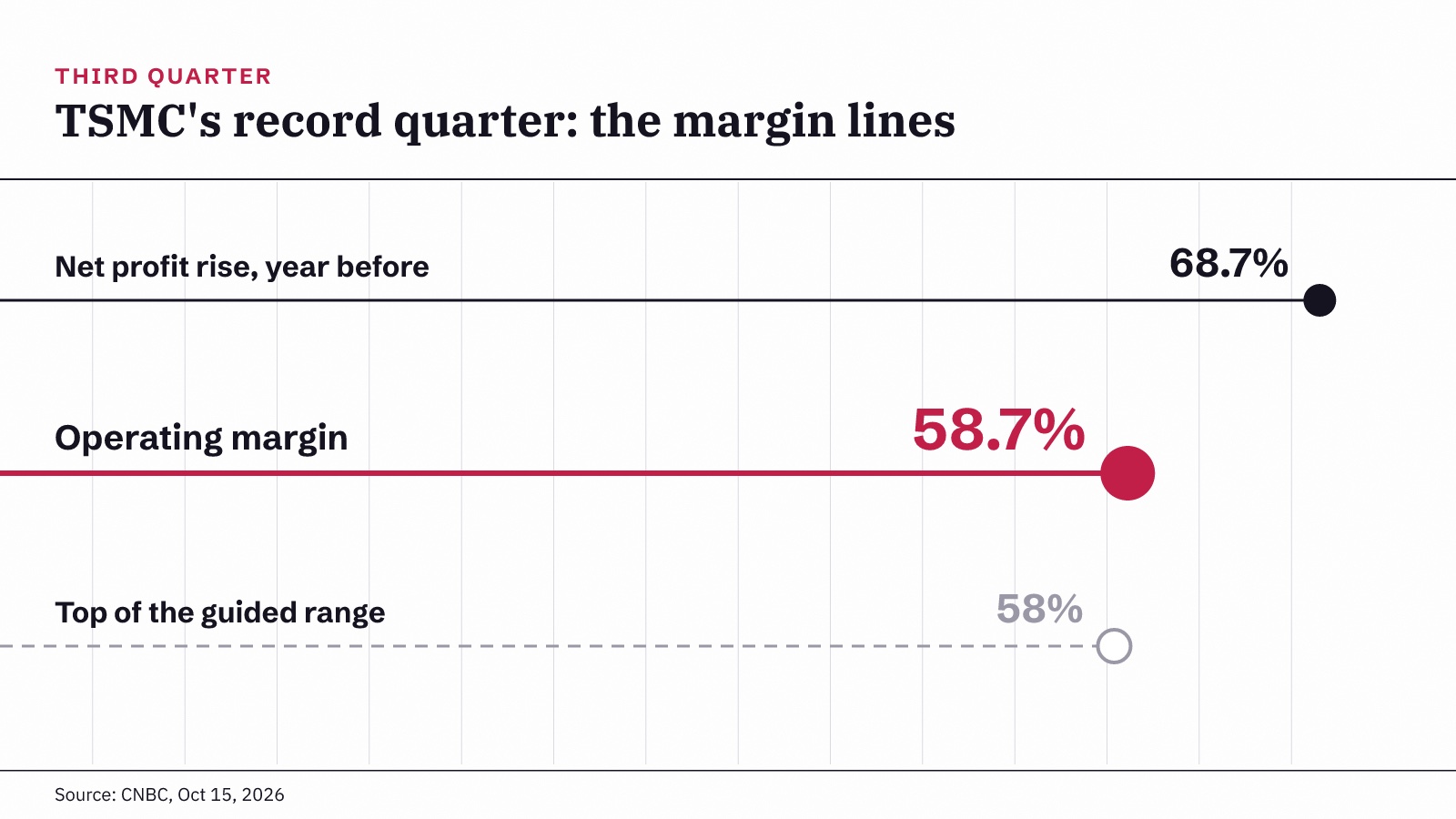
Taiwan Semiconductor Manufacturing Co. reported a record third-quarter profit on Thursday that came in above analyst estimates, CNBC reported. Most coverage stops at the word record. This article looks at three lines in the report that carry more information: the operating margin compared with the company's own guidance, the revenue range it gave for the next quarter, and the table that splits revenue by chip type and by customer platform.
The headline in plain words
TSMC makes chips that other companies design. Its third-quarter net profit was a record for the sixth quarter in a row, and it rose 68.7% from the same quarter a year earlier, according to CNBC.
CNBC measured the results against LSEG SmartEstimates. That is a consensus forecast, but not a plain average: it leans more on analysts whose past forecasts have been more accurate. When you read beat or miss in a headline, it always means beat or miss compared with some forecast, so it helps to know which one.
The number behind it: margin against guidance
The line that tells you the most here is operating margin. It is operating profit divided by revenue, shown as a percent. It answers a simple question: out of each dollar of sales, how much is left after the cost of making the product and running the business, before interest and tax?
TSMC's operating margin for the quarter was 58.7%. That alone says little to a beginner. The useful comparison is with the range TSMC had given investors beforehand. The top of that range was 58%, so the company landed above its own best case. CNBC read this as a sign of pricing power, meaning TSMC can charge more while demand for AI chips stays strong.
This is the habit worth building. A company's guidance is its own forecast, so a result above the top of the range tells you more than a result that merely beats analysts. Analysts can be too cautious. A company that beats the ceiling it set itself is saying that costs or prices moved better than it expected a few months ago.
Reading a guidance range and its midpoint
For the fourth quarter, TSMC guided revenue of $52.3 billion to $54.3 billion. Companies give a range because the future is uncertain. Analysts and news reports usually work from the midpoint, the value halfway between the low and high ends.
On the earnings call, TSMC said the midpoint implies a 14% rise from the third quarter and a 58% rise from a year earlier. Notice that these are two different comparisons. The first is sequential, quarter against the quarter just before it. The second is year over year, which removes seasonal patterns. A big year-over-year figure with a smaller sequential one is normal for a fast-growing company.
SemiAnalysis analyst Sravan Kundojjala also told CNBC that TSMC raised its full-year revenue outlook. A raised outlook is a change to guidance, and it often matters as much as the quarter that just ended.
What the mix table shows
Big chipmakers break revenue into slices. TSMC groups chips by node, the size of the manufacturing process in nanometers, where smaller usually means more advanced. Chips at 7-nanometer and finer made up 79% of wafer revenue. The 3-nanometer process alone was the largest single slice, at 33%.
By platform, high-performance computing, the category that includes AI processors, brought in 68% of revenue. Smartphones contributed 21%. Automotive grew fastest from the prior quarter, at 23%. Read that last figure with care: a fast growth rate on a small slice can still be a small amount of money. A share tells you size; a growth rate tells you direction.
Cash matters too. Free cash flow, the cash left after spending on plants and equipment, was NT$476.56 billion, compared with NT$139.38 billion a year earlier. The board approved a cash dividend of NT$7.00 for the second quarter.
What the company and an analyst said, and the risks
TSMC expects capital spending over 2026 to 2028 to be well above the prior three years. Its second Arizona plant is built and receiving equipment, with mass production now expected in the third quarter of 2027, slightly earlier than planned. In July it had laid out a planned Arizona investment of $265 billion, and it is reportedly weighing a possible investment in Texas.
Kundojjala said TSMC checks whether customers have the financing and other parts they need to deploy AI systems. "Even after those checks, TSMC says demand remains well above its supply capacity," he said. Heavy capital spending is also a risk to watch: it lowers free cash flow if demand cools, and a business this concentrated in one platform depends on that platform staying strong. Anyone who owns shares in a company like this can lose money if results or sentiment turn.
How to check this yourself next time
You can run the same three checks on any earnings release.
- Find the company's prior guidance for margin and revenue, and see where the actual result landed within, above or below that range.
- Take the midpoint of the new guidance range and note whether quoted growth is sequential or year over year.
- Open the revenue mix table and read each segment's share and growth rate together, not one without the other.
Sources
- CNBC, 15 Oct 2026
AI-drafted from the filings and reports above, then published automatically after checks that each number appears in a cited source and that no wording is copied. There was no human edit. Educational reading only, not a recommendation on any stock.