Explainer · Earnings & Analyst Ratings
SEC filings explained: 10-K, 10-Q and 8-K
Public companies tell investors about their business in three main reports: an annual 10-K, quarterly 10-Qs and event-driven 8-Ks. Here is what each one covers, when it is due and where to start reading.
Quick answer
A 10-K is the annual report with audited financial statements. A 10-Q is the quarterly report, filed for the first three quarters, with unaudited statements. An 8-K reports a major event, usually within four business days [1] [7].
Key points
- The 10-K has audited annual financial statements; the 10-Q has unaudited quarterly ones [1].
- There is no 10-Q for the fourth quarter, because the 10-K covers the full year [5].
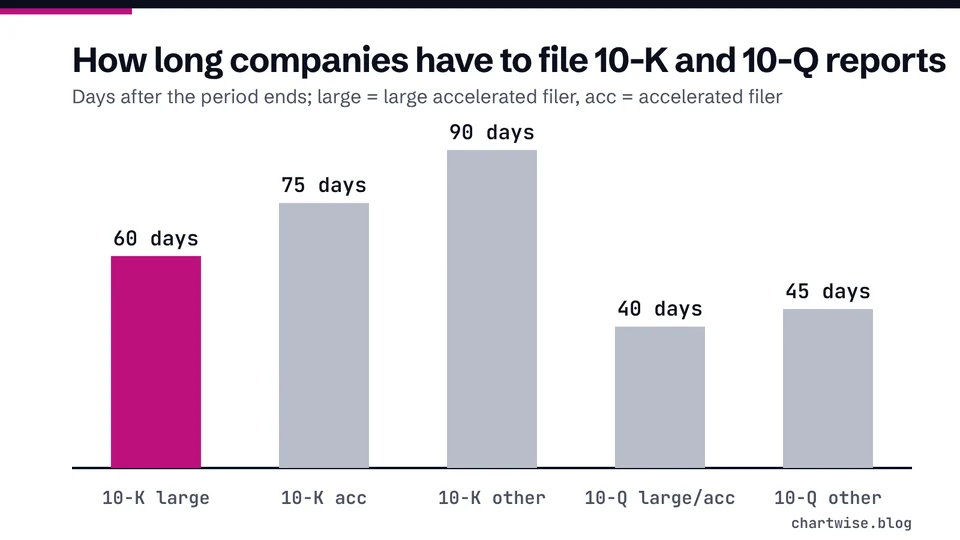
- Deadlines depend on filer status: 60, 75 or 90 days after the year ends for a 10-K, and 40 or 45 days after a quarter for a 10-Q [6] [5].
- Most 8-Ks are due within four business days of the event, including earnings announcements [7].
- Every filing is free on the SEC's EDGAR database, searchable by company name or ticker [1].
On this page
What are SEC filings?#
Public companies file reports with the Securities and Exchange Commission, and anyone can read them. The SEC's EDGAR database gives free public access, so you can research a company's finances and operations from its own filings [1].
For a beginner, three forms matter most. The 10-K is the annual report. Investor.gov describes it as a comprehensive overview of the company's business and financial condition, including audited financial statements [2]. The 10-Q is the quarterly report. The 8-K is a current report for important events between those scheduled reports [1]. Together they are the raw material behind every earnings report and behind the financial figures on our company pages.
What is the difference between a 10-K and a 10-Q?#
The short answer is scope and assurance. The 10-K covers a full fiscal year and its financial statements are audited by an independent accountant [3]. The 10-Q covers a single quarter, is filed after the first, second and third quarters, and contains unaudited statements [4] [1]. The 8-K is not tied to a calendar at all. The comparison below sets the three side by side.
| Feature | Form 10-K | Form 10-Q | Form 8-K |
|---|---|---|---|
| Period covered | Full fiscal year | One quarter (first three only) | A specific event |
| Financial statements | Audited | Unaudited | Depends on the event |
| Filing deadline | 60, 75 or 90 days after year end | 40 or 45 days after quarter end | Usually four business days |
| Read it for | The full picture and risks | Recent trends | News between reports |
Sources: contents and audit status [1] [3]; no fourth-quarter 10-Q and 10-Q deadlines [5]; 10-K deadlines by filer status [6]; 8-K timing [7]. The shorter deadlines apply to large accelerated and accelerated filers.
The deadline depends on the company's filer status. A 10-K is due 60 days after the fiscal year ends for large accelerated filers, 75 days for accelerated filers and 90 days for all other companies [6]. A 10-Q is due 40 days after the quarter for large accelerated and accelerated filers and 45 days for everyone else [5].
What is inside a 10-K?#
A 10-K is organized into numbered items set out in the SEC's form [6]. You do not have to read it front to back. These five stops cover most of what a beginner needs.
- Item 1, Business
What the company does and how it makes money. The SEC calls it a good place to start to understand how the company operates [3].
- Item 1A, Risk Factors
The most significant risks that apply to the company, in its own words [4].
- Item 3, Legal Proceedings
Significant pending lawsuits or other legal proceedings, other than ordinary litigation [3].
- Item 7, MD&A
Management's Discussion and Analysis: the company's perspective on the results of the past financial year [4].
The 10-K is not the same document as the annual report to shareholders that a company may also publish. The SEC notes that the 10-K typically includes more detailed information than the annual report to shareholders [3]. The 10-Q follows a shorter layout: financial statements, MD&A, market risk disclosures and controls and procedures [5].
When is each filing due during the year?#
A company produces three 10-Qs and one 10-K for each fiscal year, plus as many 8-Ks as events require. The fiscal year does not have to match the calendar year.
What is an 8-K and when is it filed?#
An 8-K is a current report. It discloses material events or information that a company chooses or is required to make public before its next quarterly or annual report [1]. Unless the form says otherwise, it is due within four business days after the event [7].
The SEC's 8-K bulletin lists events such as a bankruptcy or receivership filing, the completion of an acquisition or disposition of assets, the departure of directors or certain officers, and results of operations and financial condition [12]. Information in an 8-K is generally considered material, meaning a reasonable investor would likely consider it important in an investment decision [12].
Earnings announcements arrive this way: a company that issues an earnings press release must file it on Form 8-K [13]. Item 2.02 of Form 8-K covers any public announcement of material non-public information about results for a completed quarter or year [7]. Information given under Item 2.02 or Item 7.01, Regulation FD Disclosure, is generally not deemed filed for purposes of Section 18 of the Exchange Act [7], which is why you may see such an 8-K described as furnished rather than filed.
How do you find a company's filings on EDGAR?#
EDGAR is free. Investor.gov's instructions are to type the company's name or ticker symbol in the search bar on the EDGAR home page [1]. Then look for the form type you need. Besides the three forms on this page you will see the DEF 14A, the final proxy statement sent to shareholders before a shareholder meeting, and Form 4, which discloses insiders' transactions in the company's shares within two business days [1]. Our guide to Form 4 and insider trading covers that one.
Mistakes beginners make with SEC filings#
- Treating quarterly numbers as audited
10-Q statements are unaudited, while the 10-K's annual statements are audited [1].
- Looking for a fourth-quarter 10-Q
There is none. The fourth quarter is covered by the 10-K [5], so you may need to subtract the first three quarters from the full year to see it.
- Reading only the press release
The earnings release in an 8-K is a summary. The 10-Q or 10-K has the full statements and risk updates [1].
- Skipping the risk factors
Item 1A is where the company itself lists its most significant risks [4]. It is worth reading before any analyst's view.
- Assuming the fiscal year is the calendar year
Some companies, Microsoft included, end their year in another month [9]. Check the period on the cover before comparing companies.
Frequently asked questions#
Is the 10-K the same as the annual report?
Not exactly. A company may also send shareholders an annual report, but the SEC notes the 10-K typically includes more detailed information [3].
Are 10-Q financial statements audited?
No. The 10-Q provides unaudited quarterly financial statements; the 10-K provides audited annual statements [1].
How long does a company have to file a 10-K?
60 days after the fiscal year ends for large accelerated filers, 75 days for accelerated filers and 90 days for all other companies [6].
Do I have to pay to read SEC filings?
No. EDGAR provides free public access to the filings companies make with the SEC [1].
The bottom line#
The 10-K gives you the audited annual picture, the 10-Q updates it each quarter without an audit, and the 8-K brings news in between, usually within four business days. All three are free on EDGAR. Start with the latest 10-K's business description, risk factors, MD&A and financial statements, then move forward through the newer filings. Filings tell you what a company reported; they do not tell you whether its shares are worth buying, and stocks can lose value.
Sources
- Using EDGAR to Research Investments.
- Form 10-K | Investor.gov.
- Investor Bulletin: How to Read a 10-K.
- How to Read a 10-K/10-Q | Investor.gov.
- Form 10-Q General Instructions (SEC 1296 (02-25)).
- Form 10-K (SEC 1673 (02-25)).
- Form 8-K General Instructions (SEC 873 (02-25)).
- Beginners' Guide to Financial Statements.
- Microsoft Corporation Form 10-K for the fiscal year ended June 30, 2026.
- SEC Proposes Amendments to Permit Optional Semiannual Reporting for Public Companies.
- Semiannual Reporting (File No. S7-2026-15).
- Investor Bulletin: How to Read an 8-K.
- What Is Earnings Season?.
Education only. This page is not investment, tax or legal advice. Stocks can lose value. See our risk disclosure.