Glossary
Free cash flow
Profit tells you whether a company earned money on paper. Free cash flow asks a narrower question: how much cash was left after the business paid to keep and grow its equipment.
Free cash flow is the cash a company's operations brought in during a period after paying for capital expenditures such as buildings and equipment. It is not a GAAP line item, so each company that reports it chooses its own definition.
Quick answer
Free cash flow is typically calculated as cash flow from operating activities minus capital expenditures [2]. It is a non-GAAP measure with no uniform definition, so always check how a company calculates it [2].
Key points
- The common formula is operating cash flow minus capital expenditures, both taken from the statement of cash flows [2].
- There is no uniform definition, and the SEC staff says free cash flow must not be shown per share [2].
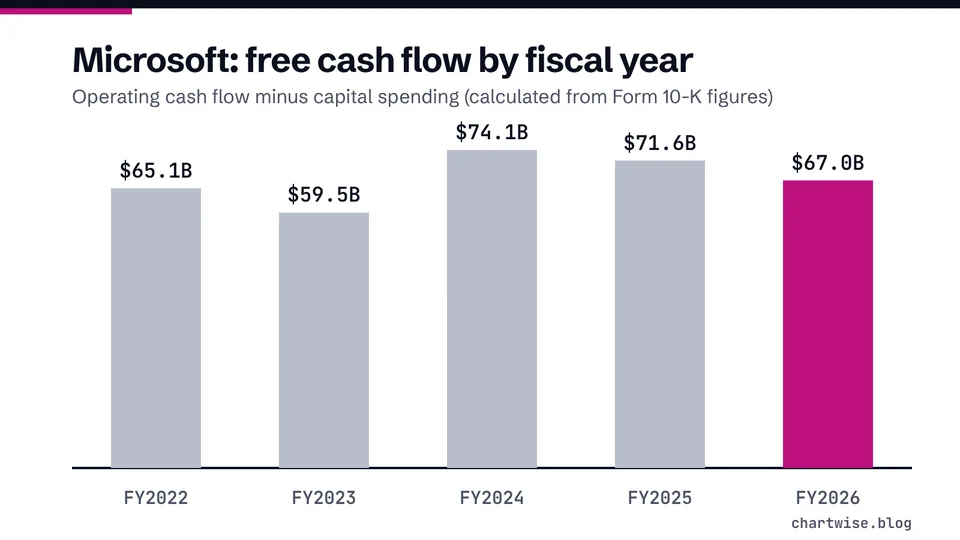
- Heavy spending on equipment can shrink free cash flow even while operating cash flow grows, as Microsoft's fiscal 2026 figures show (calculated) [3].
On this page
How do you calculate free cash flow?#
Take two numbers from the statement of cash flows, which is one of the primary financial statements a company prepares [1]. The SEC staff describes free cash flow as typically calculated as cash flows from operating activities, as presented under GAAP, less capital expenditures [2].
Operating activities are the transactions tied to the company's principal business operations [1]. Capital expenditures sit in the investing section, which covers the purchase or sale of long-term assets [1]. In a filing they often carry a label such as "purchases of property and equipment" [1] or, at Microsoft, "additions to property and equipment" [3].
Free cash flow = cash from operating activities - capital expenditures
What does free cash flow look like for a real company?#
Microsoft does not print a free cash flow line on its statement of cash flows, so the last column below is our own calculation from two lines it does report [3]. Figures are in millions of dollars for fiscal years ended June 30, as reported in its Form 10-K for fiscal 2026.
| Fiscal year | Operating cash | Capital spending | Free cash flow |
|---|---|---|---|
| Fiscal 2024 | $118,548 | $44,477 | $74,071 |
| Fiscal 2025 | $136,162 | $64,551 | $71,611 |
| Fiscal 2026 | $182,935 | $115,948 | $66,987 |
Operating cash = net cash from operations; capital spending = additions to property and equipment, from Microsoft's cash flows statement [3]. Free cash flow calculated.
Free cash flow also differs from net income. Microsoft's fiscal 2026 net income was $133,749 million [3], 1.997 times its free cash flow (calculated). One reason the two diverge: the cash flow statement starts from net income and adds back items that did not affect cash, such as depreciation [1], while the cost of equipment reaches the income statement gradually, as depreciation over the asset's estimated useful life [5]. See our income statement guide for where net income comes from.
Why does free cash flow have no single definition?#
Because it is not a GAAP line item. Free cash flow is a non-GAAP measure, and the SEC staff warns that it has no uniform definition and that its title does not describe how it is calculated [2]. For that reason, a company that uses it should give a clear description of the calculation and a reconciliation [2]. In SEC filings, the most directly comparable GAAP measure must be presented with equal or greater prominence than the non-GAAP one [6].
Two more rules from the SEC staff are worth knowing: free cash flow is treated as a liquidity measure, and it must not be presented on a per share basis [2]. When two companies both report "free cash flow", read each one's definition before you compare them.
Frequently asked questions#
Is free cash flow the same as net income?
Can free cash flow be negative?
Yes. If capital expenditures are larger than cash from operating activities, the subtraction gives a negative number. That alone does not tell you whether the spending was wise; read the 10-K to see what the money paid for.
Where do I find the numbers?
In the statement of cash flows in a company's 10-K or 10-Q. Operating cash flow is the total of the operating section; capital expenditures are in the investing section, which covers purchases of long-term assets [1]. Our SEC filings guide shows how to find those reports.
The bottom line#
Free cash flow is a simple subtraction, operating cash flow minus capital expenditures, but it is not a standardized number. Calculate it yourself from the statement of cash flows, check how a company defines it before comparing, and read it next to net income rather than instead of it. A falling figure can reflect heavy investment as much as weak operations, so the 10-K text matters as much as the arithmetic.
Sources
- What is a statement of cash flows?.
- Non-GAAP Financial Measures (Compliance and Disclosure Interpretations).
- CASH FLOWS STATEMENTS (Microsoft Corporation Form 10-K for the fiscal year ended June 30, 2026, R6).
- Microsoft Corporation Form 10-K for the fiscal year ended June 30, 2026.
- What is an income statement?.
- 17 CFR 229.10 (Item 10) General.
Education only. This page is not investment, tax or legal advice. Stocks can lose value. See our risk disclosure.