Glossary
Net income
Net income is the number most headlines mean when they say a company "earned" something. It is the last line of the income statement, and the starting point for earnings per share.
Net income is the profit a company has left for a period after subtracting every cost, interest expense and income tax from its revenue. A negative result is a net loss.
Quick answer
Net income is the profit a company earns after all expenses and taxes have been deducted from revenue [12]. It is the bottom line of the income statement [1]. Divide it by the number of common shares and you get earnings per share [8].
Key points
On this page
How do you get from revenue to net income?#
The income statement subtracts costs in a fixed order. The SEC describes the bottom line as net earnings or losses [1], and its small-business guide defines net income as the profit made after subtracting all expenses from revenue [2]. That guide includes a worked example for a hypothetical company, reproduced below. The "Per $100 of revenue" column is ours.
| Line of the income statement | Amount | Per $100 of revenue |
|---|---|---|
| Revenue | $835,000 | $100.00 |
| Cost of goods sold | ($250,000) | ($29.94) |
| Gross profit | $585,000 | $70.06 |
| Operating expenses | ($210,000) | ($25.15) |
| Operating profit | $375,000 | $44.91 |
| Interest expense | ($7,000) | ($0.84) |
| Income before income taxes | $368,000 | $44.07 |
| Income tax expense | ($77,000) | ($9.22) |
| Net income | $291,000 | $34.85 |
Hypothetical company from the SEC income statement guide [2]. Last column calculated.
Operating profit shows what the business itself earned. Interest and taxes are then subtracted to reach net income. Those last two lines matter: a 2022 Federal Reserve staff note found that falling interest and tax expenses accounted for a full one-third of profit growth for S&P 500 nonfinancial companies over the prior two-decade period [3]. So net income can grow faster than the business that produces it.
Where do you find net income in a 10-K?#
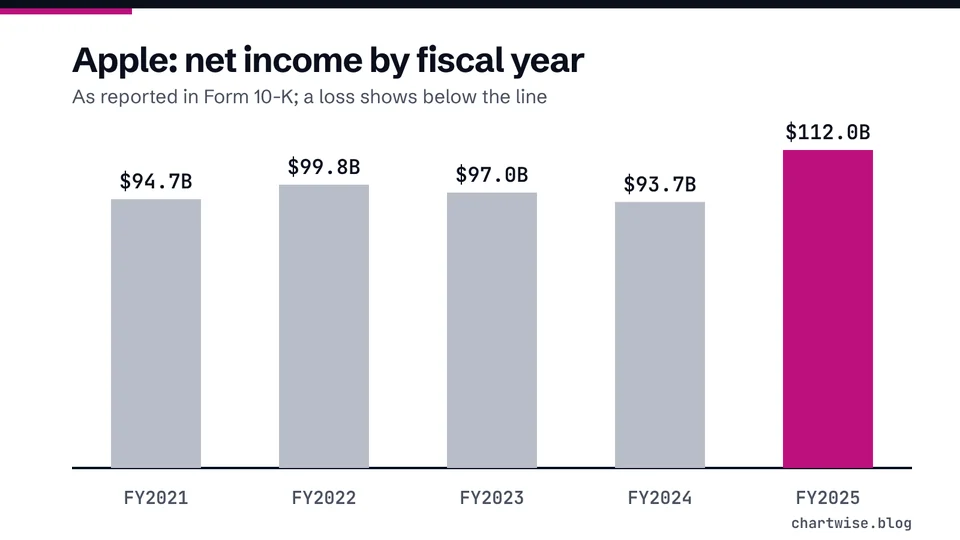
Near the bottom of the income statement, which some companies title the statement of operations [4]. The SEC's Regulation S-X lists "Net income or loss" as one of the line items that should appear on the face of the statement, followed by earnings per share data [5]. Read it together with the lines above it, which the income statement guide walks through.
Companies sometimes also publish "adjusted" profit figures. Under the SEC's Regulation G, a company that publishes such a non-GAAP measure must also show the most directly comparable GAAP measure and reconcile the two [6]. Net income in the audited statements is the GAAP number.
What does net income feed into?#
- Earnings per share. Basic EPS is net income divided by common shares outstanding; dividends on preferred shares are subtracted first [8]. See earnings per share explained.
- The P/E ratio. P/E is the share price divided by EPS [9], so it rests on net income. Try the P/E ratio calculator.
- Profit margin. Net income divided by revenue for the same 12-month period, shown as a percentage [10].
- Return on equity. Net income for the past 12 months divided by common stockholder equity [11].
Frequently asked questions#
Is net income the same as cash?
No. Net income is an accounting result on the income statement. The cash flow statement separately reports cash coming in and going out from operating, investing and financing activities [1], and the two can differ.
What is the difference between net income and revenue?
Can net income be negative?
Yes. If expenses, interest and taxes exceed revenue, the bottom line is a net loss [1]. EPS is then negative, and our P/E calculator shows the ratio as not meaningful.
The bottom line#
Net income is the bottom line, but read it with the lines above it. Check how much came from operations and how much from lower interest or taxes, look for one-off items and adjusted figures, and compare it with revenue to see the margin. Then follow it into EPS and the P/E ratio.
Sources
- Beginners' Guide to Financial Statements.
- What is an income statement?.
- The coming long-run slowdown in corporate profit growth and stock returns.
- CONSOLIDATED STATEMENTS OF OPERATIONS (Apple Inc. Form 10-K for the fiscal year ended September 27, 2025, R3).
- 17 CFR 210.5-03 Statements of comprehensive income.
- 17 CFR Part 244 Regulation G.
- EARNINGS PER SHARE (Microsoft Corporation Form 10-K for the fiscal year ended June 30, 2026, R12).
- Financial Performance Metrics Every Investor Should Know.
- Evaluating Stocks.
- Profit Margin.
- Return on Equity (ROE).
- Net Income.
Education only. This page is not investment, tax or legal advice. Stocks can lose value. See our risk disclosure.