Explainer · Risk, Costs & Protection
SIPC protection explained
SIPC protects the stocks and cash in your brokerage account if the firm itself fails and your assets are missing. It does not protect you from falling prices. Here is exactly what it covers, with calculated examples.
Quick answer
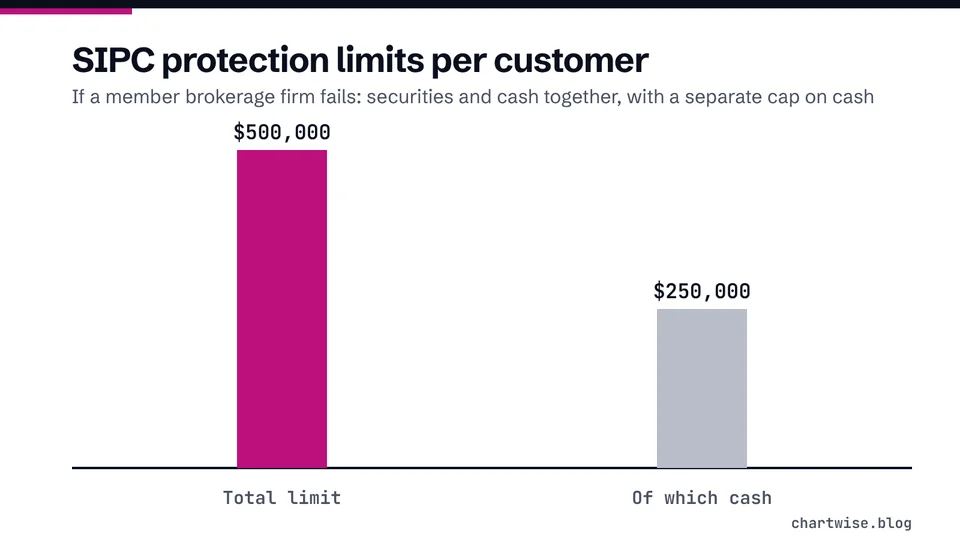
SIPC protects customers of a failed member brokerage firm up to $500,000, including up to $250,000 in cash [4]. It does not protect against the decline in value of your securities or bad investment advice [4], and it is not the same as FDIC bank insurance.
Key points
- The limit is $500,000 per customer, including a $250,000 limit for cash [4].
- Accounts held in separate capacities, such as an individual account and a Roth IRA, are each protected up to $500,000 [5].
- SIPC does not cover market losses, commodities, futures or most crypto assets [4] [3].
- SIPC is not a regulator and does not investigate active firms [3].
- Most U.S. brokerage firms are required to be SIPC members; you can check the list [2].
On this page
What is SIPC and what does it do?#
The Securities Investor Protection Corporation (SIPC) was created by the Securities Investor Protection Act of 1970 [1]. It describes itself as a non-profit corporation created by Congress [2]. Its job is narrow: the SEC explains that SIPC protection helps address your risk of losing the securities and cash held by your brokerage firm if the firm fails or goes out of business [3].
When a member firm is liquidated, SIPC works to restore to customers the securities and cash that were in their accounts when the liquidation began [4]. SIPC is not a regulator, and it has no authority to investigate active brokerage firms [3]. A brokerage account at a member firm is what SIPC protects.
How much does SIPC protect?#
The limit of SIPC protection is $500,000, which includes a $250,000 limit for cash [4]. The cash covered is cash the broker holds for you in connection with buying or selling securities [4]. Protected securities include stocks, bonds, Treasury securities, certificates of deposit, mutual funds and money market mutual funds [4].
The limit applies per customer in each separate capacity. SIPC's brochure says each account held in a separate capacity is protected up to $500,000, and lists examples such as an individual account, a joint account, an IRA and a Roth IRA [5]. The SEC adds accounts for a trust, a corporation and a guardian for a minor [3].
What does SIPC not protect?#
Two kinds of loss sit outside SIPC. The first is any loss of value. The second is any asset that is not a protected security under the law. The table below sorts common examples.
| Item | Protected by SIPC? |
|---|---|
| Stocks, bonds, Treasury securities | Yes, up to the limit |
| Mutual funds and money market funds | Yes, up to the limit |
| Cash held to buy securities | Yes, up to $250,000 |
| A fall in the price of your stocks | No |
| Losses from bad advice | No |
| Commodity futures and foreign exchange trades | No (futures only in a special portfolio margining account) |
| Gold, silver and other commodities | No |
| Unregistered investment contracts and fixed annuities | No |
| Most crypto assets | No |
From SIPC [4] and the SEC's SIPC bulletin [3].
How is SIPC different from FDIC insurance?#
FDIC insurance covers bank deposits: $250,000 per depositor, per FDIC-insured bank, for each account ownership category [6]. The FDIC does not insure stocks, bonds, mutual funds, annuities, Treasury securities or crypto assets [6]. SIPC itself says its protection is not the same as FDIC protection for bank cash, because SIPC does not protect the value of any security [4].
The two can meet in the cash part of a brokerage account. Broker-dealers offer cash sweep programs to manage uninvested cash [7]. Cash swept to a bank deposit in a bank sweep program gets FDIC insurance up to $250,000 per customer at each insured bank, while cash swept into a money market fund or left as a free credit balance may be protected by SIPC [7]. Check your account documents to see which program you are in.
What happens if your brokerage firm fails?#
If a member firm is liquidated, SIPC's brochure says that unless your account has been transferred in full to another SIPC member firm and the trustee has said no claim is required, you should file a claim [5]. With smaller failures, SIPC sometimes deals directly with customers in an out-of-court direct payment procedure [5].
SIPC's history page, which gives no as-of date for these figures (checked October 2026), says that since 1970 SIPC has advanced $3.6 billion to make possible the recovery of $143.8 billion in assets for an estimated 773,000 investors [1]. It also says no fewer than 99 percent of eligible persons get their investments back with its help, while noting that not every investor or transaction is protected [1].
How can you check that your broker is a SIPC member?#
- Look for Member SIPC
Member firms must say they are SIPC members in their offices, on their website and in ads [3].
- Confirm on SIPC's list
Most U.S. brokerage firms are required to be members, but check SIPC's member list rather than assuming [2].
- Keep your records
Save trade confirmations and your latest monthly or quarterly statement [5]. They support a claim if one is ever needed.
- Know where your cash sits
Check whether idle cash is in a bank sweep or a money market fund sweep, since the protection differs [7].
Mistakes beginners make with SIPC protection#
- Thinking SIPC covers market losses
It does not protect against the decline in value of your securities [4].
- Holding large idle cash balances
Cash protection is capped at $250,000 within the $500,000 limit [4].
- Assuming crypto or commodities are covered
Most crypto assets, gold, silver and futures are outside SIPC protection [3].
- Not checking membership
Most, not all, U.S. brokerage firms are required to be members [2]. Check the list.
Frequently asked questions#
Is SIPC a government agency?
Does SIPC cover my losses if my stocks fall?
No. SIPC does not protect against the decline in value of your securities [4]. It protects against missing assets when a member firm fails.
Do I have $500,000 of protection per account?
Per separate capacity. An individual account, a joint account and an IRA are separate capacities, each protected up to $500,000 [5].
The bottom line#
SIPC is a safety net for one specific event: your brokerage firm failing with customer assets missing. It covers up to $500,000 per customer in each separate capacity, with cash capped at $250,000, and it never covers falling prices. Check that your firm is a member, know where your idle cash is swept, and keep your statements. Then look at the costs you pay every day in brokerage fees and hidden costs, and read our risk disclosure.
Sources
Education only. This page is not investment, tax or legal advice. Stocks can lose value. See our risk disclosure.