How to read a balance sheet
A balance sheet lists what a company owns, what it owes and what is left for its shareholders on one date. Read it in that order and every line falls into place.

What this page covers
- A balance sheet describes one date, such as the last day of the fiscal year, while the income statement covers a period [1] [8].
- Assets = liabilities + equity, which is why the statement always balances [1].
- Current means within about a year: assets expected to turn into cash, and obligations due, within 12 months [1].
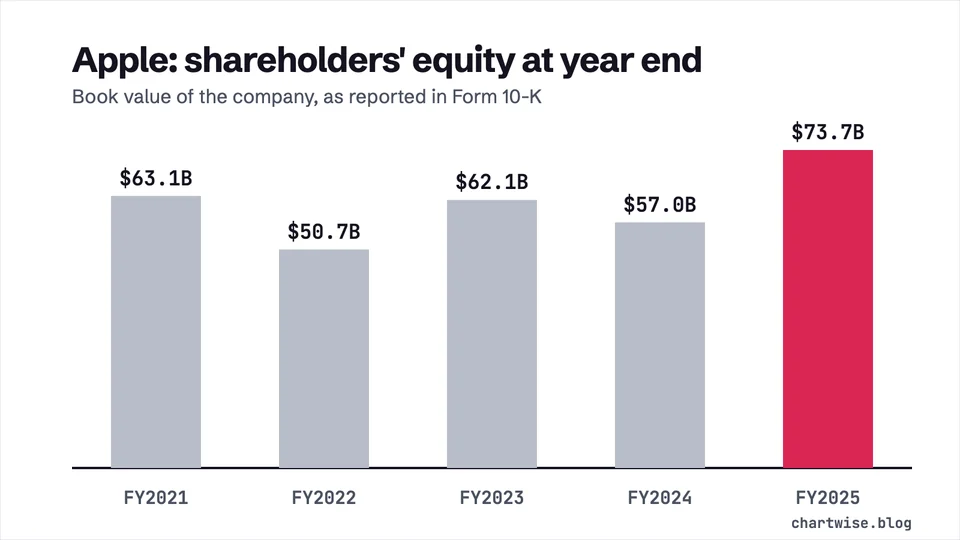
- Apple ended fiscal 2025 with $359,241 million of assets, $285,508 million of liabilities and $73,733 million of shareholders' equity [3].
- Two quick numbers come straight from the statement: working capital and the debt-to-equity ratio [2].
On this page
What is a balance sheet?#
A balance sheet is one of the primary financial statements a company prepares, and it shows the company's financial condition at a specific point in time, for instance as of June 30 [1]. The SEC's beginners' guide calls it a snapshot of a company's assets, liabilities and shareholders' equity at the end of the reporting period [2]. Apple titles its version "Consolidated Balance Sheets" [3].
It is one of four main financial statements, together with the income statement, the cash flow statement and the statement of shareholders' equity [2]. US public companies include audited annual statements in Form 10-K and file a 10-Q after each of the first three fiscal quarters [4]. Our guide to 10-K, 10-Q and 8-K filings shows where each statement sits inside a filing.
The three building blocks have short, precise definitions. The SEC describes assets as what the entity owns and liabilities as what it owes, and equity as the difference between the two, or residual interest [1]. The accounting standard setter, the FASB, defines an asset as a present right of an entity to an economic benefit and a liability as a present obligation to transfer an economic benefit [5]. Equity, which the FASB also calls net assets, is what remains of the assets after deducting the liabilities [5].
How is a balance sheet organized?#
The statement gets its name because total assets must equal total liabilities plus equity, so it balances. The SEC calls this the fundamental accounting equation: assets = liabilities + equity [1]. Assets come first and are generally listed by how quickly they will be converted into cash [2]. Liabilities follow, short-term before long-term, and shareholders' equity closes the statement.
The SEC's own example uses a small hypothetical company as of June 30. The table below copies its figures exactly [1].
| Line item | Amount | What it means |
|---|---|---|
| Current assets | $275,000 | Can turn into cash within 12 months |
| Long-term assets | $75,000 | Not readily turned into cash |
| Total assets | $350,000 | Everything the company owns |
| Current liabilities | $95,000 | Due within the next 12 months |
| Long-term liabilities | $25,000 | Due more than a year ahead |
| Total liabilities | $120,000 | Everything the company owes |
| Common stock | $500 | Shares issued times par value |
| Additional paid-in capital | $124,500 | Paid for shares above par |
| Retained earnings | $105,000 | Cumulative profit or loss since inception |
| Total stockholders' equity | $230,000 | Assets minus liabilities |
| Total liabilities and equity | $350,000 | Equals total assets |
Figures from the SEC's example balance sheet for a hypothetical company [1].
- Read current assets
These can be converted to cash within 12 months, like cash and cash equivalents, accounts receivable and inventory [1].
- Read long-term assets
Property, equipment, patents, trademarks and goodwill are not readily converted to cash [1].
- Read liabilities, short then long
Current liabilities are due within 12 months, such as accounts payable and the current portion of long-term debt; long-term liabilities are due later [1].
- Finish with equity
Equity is total assets minus total liabilities. The SEC notes it is sometimes called book value [1].
What do current and long-term mean?#
The dividing line is about one year. Current assets are things a company expects to convert to cash within one year, and current liabilities are obligations it expects to pay off within the year [2]. Everything else is long-term, or non-current: assets not readily converted to cash, and obligations due more than a year in the future [1].
A few line items appear on almost every balance sheet. Accounts receivable are amounts customers owe for goods or services bought on credit, and accounts payable are amounts the company owes its own vendors on the same basis [1]. Goodwill is an intangible asset that arises when a company buys another business and pays more than the fair market value of its net assets [1]. Shares a company buys back from its shareholders can be held as treasury stock [1].
What does a real balance sheet look like?#
Apple's consolidated balance sheet in its fiscal 2025 Form 10-K shows two dates side by side: September 27, 2025 and September 28, 2024, with dollar amounts in millions [3]. The figures below are as reported in that 10-K. You can see more on the Apple company page.
- Total current assets
- $147,957 millionForm 10-K balance sheet [3]
- Total assets
- $359,241 millionForm 10-K balance sheet [3]
- Total current liabilities
- $165,631 millionForm 10-K balance sheet [3]
- Total liabilities
- $285,508 millionForm 10-K balance sheet [3]
- Total shareholders' equity
- $73,733 millionForm 10-K balance sheet [3]
- Liabilities plus equity
- $359,241 millioncalculated: 285,508 + 73,733, equal to total assets
Read it the same way as the SEC example. Current assets include $35,934 million of cash and cash equivalents, $18,763 million of marketable securities, $39,777 million of accounts receivable and $5,718 million of inventories [3]. Current assets were 41.19% of total assets (calculated). Among non-current assets, Apple lists $77,723 million of marketable securities and $49,834 million of property, plant and equipment, net [3]. On the other side, current liabilities include $69,860 million of accounts payable, $7,979 million of commercial paper and $12,350 million of term debt due within the year, with another $78,328 million of term debt in non-current liabilities [3].
Which numbers can you calculate from a balance sheet?#
Two simple measures come straight from the statement. The SEC's guide defines working capital as current assets minus current liabilities: the money left over if a company paid its debts due within one year from its current assets [2]. It defines the debt-to-equity ratio as total liabilities divided by shareholders' equity, and explains that a ratio of 2 to 1 means two dollars of debt for every dollar shareholders invest [2].
| Company and date | Working capital | Debt-to-equity |
|---|---|---|
| SEC example, June 30 | $180,000 | 0.52 |
| Apple, Sept 27, 2025 | -$17,674 million | 3.87 |
| Apple, Sept 28, 2024 | -$23,405 million | 5.41 |
Calculated from the SEC example [1] and Apple's 10-K balance sheet [3], using the SEC's formulas [2].
The same formula gives very different results for different businesses. Apple's current liabilities exceeded its current assets at both dates, so its working capital was negative (calculated from [3]), while the SEC's small example company has $180,000 of working capital (calculated). The SEC's guide notes that, as a general rule, desirable ratios vary by industry [2], so treat them as starting points for questions, not verdicts. Look at the cash flow statement to see how much cash the business generates, and at the footnotes, which the SEC calls packed with information [2].
Equity is also the starting point for two ratios covered elsewhere on ChartWise. Book value and the price-to-book ratio divides equity by the share count and compares it with the share price, and return on equity and profit margins puts net income over equity.
How does the balance sheet connect to the other statements?#
The four statements describe the same company from different angles, and some numbers pass from one to another. The SEC describes retained earnings as the cumulative net profit or loss since inception [1], so each year's net income from the income statement flows into equity. Distributions such as dividends reduce it [2], and Apple also charges share repurchases to it [6].
Apple shows why that matters. Its statement of shareholders' equity for fiscal 2025 starts the retained earnings column at an accumulated deficit of $19,154 million, adds net income of $112,010 million, then subtracts $15,413 million of dividends declared, $90,052 million of share repurchases and $1,655 million of shares withheld for employee tax, ending at an accumulated deficit of $14,264 million [6]. Dividends and repurchases in that column came to 94.16% of the year's net income (calculated). A highly profitable company can still show negative retained earnings when it returns more than it keeps.
Cash ties the balance sheet to the cash flow statement. Apple's cash and cash equivalents of $35,934 million on the September 27, 2025 balance sheet [3] match the ending balance on its fiscal 2025 cash flow statement [7]. Our guide to how to read a cash flow statement follows that cash through the year.
Mistakes beginners make with balance sheets#
- Reading it as a period
A balance sheet shows one date, not a year of activity [1]. For what happened during the year, read the income statement and the cash flow statement.
- Judging one ratio alone
The SEC's guide notes that desirable ratios vary by industry [2]. Apple and the SEC's example give very different results from the same formulas (calculated).
- Skipping the comparison column
Apple's 10-K shows two balance sheet dates side by side [3]. A change between them tells you more than one date alone.
- Ignoring the notes
The SEC calls the footnotes packed with information [2]. They explain accounting policies, income taxes, pensions and stock options that the face of the statement only summarizes.
Questions readers ask#
Where do I find a company's balance sheet?
Why does a balance sheet always balance?
Because equity is defined as assets minus liabilities, total assets always equal liabilities plus equity [1]. If the two sides differ, the statement contains an error.
Is shareholders' equity the same as book value?
The SEC notes that stockholders' equity is sometimes called book value [1]. Divide it by the number of shares and you get book value per share, covered in our price-to-book guide.
What does negative retained earnings mean?
Retained earnings are cumulative profit or loss since inception [1], less what has been paid out. At Apple, dividends, share repurchases and shares withheld are charged to that line. In fiscal 2024 those charges were larger than net income, and the line still showed an accumulated deficit of $14,264 million at September 27, 2025 [6].
Does a strong balance sheet mean the stock will go up?
No. A balance sheet describes one past date, and share prices also reflect expectations. Nothing on this page is a recommendation to buy or sell any stock, and stocks can lose value.
In one paragraph#
Read a balance sheet in order: the date, current assets, long-term assets, current liabilities, long-term liabilities, then equity. Check that the two sides balance, compare the two dates, and calculate working capital and debt-to-equity as prompts for questions rather than answers. Then read the income statement and the cash flow statement, which explain how the balance sheet changed between the two dates.
Sources
- What is a balance sheet?.
- Beginners' Guide to Financial Statements.
- CONSOLIDATED BALANCE SHEETS (Apple Inc. Form 10-K for the fiscal year ended September 27, 2025, R5).
- How to Read a 10-K/10-Q | Investor.gov.
- Statement of Financial Accounting Concepts No. 8, Conceptual Framework for Financial Reporting, Chapter 4, Elements of Financial Statements.
- CONSOLIDATED STATEMENTS OF SHAREHOLDERS' EQUITY (Apple Inc. Form 10-K for the fiscal year ended September 27, 2025, R7).
- CONSOLIDATED STATEMENTS OF CASH FLOWS (Apple Inc. Form 10-K for the fiscal year ended September 27, 2025, R8).
- What is an income statement?.
Education only. This page is not investment, tax or legal advice. Stocks can lose value. See our risk disclosure.



_02.jpg)