How to read a cash flow statement
Profit and cash are not the same thing. The cash flow statement shows where a company's cash actually came from during a period and where it went.

What this page covers
- An income statement tells you whether a company made a profit; a cash flow statement tells you whether it generated cash [2].
- Three sections: operating, investing and financing activities [1].
- The SEC notes that fewer companies, generally only smaller ones, use the direct method; the indirect method starts from net income and adjusts for items that did not affect cash, such as depreciation [1].
- Apple generated $111,482 million of cash from operations in fiscal 2025 and spent $90,711 million repurchasing its own shares [4].
- Free cash flow is usually operating cash flow minus capital expenditures, but it has no uniform definition [6].
On this page
What is a cash flow statement?#
The statement of cash flows is one of the primary financial statements a company prepares [1]. It shows how cash moves in and out of the business, and it reconciles the change in the cash balance from the beginning to the end of the reporting period [1]. Where a balance sheet is a snapshot of one date, the SEC notes that a cash flow statement shows changes over time [2].
The SEC's beginners' guide puts the difference with the income statement in one line: an income statement can tell you whether a company made a profit, while a cash flow statement can tell you whether the company generated cash [2]. Both matter: the guide notes that a company needs enough cash on hand to pay its expenses and purchase assets [2]. The guide adds that cash flows are related, but not equivalent, to the net income on the income statement, and for most companies the operating section reconciles the two [2].
US public companies include the statement in their annual Form 10-K, with audited financial statements, and in each 10-Q [3]. Apple, for example, titles its version "Consolidated Statements of Cash Flows" and shows three fiscal years side by side [4].
What are the three sections of a cash flow statement?#
Cash flow statements are generally divided into three main parts [2]. The three totals add up to the net increase or decrease in cash for the period, and in the SEC's example cash going out is shown in brackets [1].
| Section | Typical lines |
|---|---|
| Operating activities | Net income, depreciation, changes in receivables, inventory and payables |
| Investing activities | Purchases of property and equipment, buying or selling securities |
| Financing activities | Borrowing and repaying loans, issuing or repurchasing stock, paying dividends |
Typical lines in each section: operating activities relate to the principal business operations, investing activities to buying or selling long-term assets or investments, and financing activities to owners and creditors. From the SEC's statement of cash flows building block [1] and beginners' guide [2].
The SEC gives simple examples. If a company buys a piece of machinery, that is a cash outflow from investing activities; if it sells investments from its portfolio, the proceeds are an investing inflow [2]. Selling stocks and bonds or borrowing from banks are typical financing inflows, and paying back a bank loan is a financing outflow [2]. Repurchasing stock and paying dividends also sit in financing [1].
How does net income become operating cash flow?#
There are two ways to prepare the operating section. The direct method lists actual cash receipts and payments. The indirect method starts with net income and adjusts for changes that did not affect cash, such as depreciation, and for changes in current assets and current liabilities [1]. The SEC notes that most domestic companies use accrual-based accounting, which aligns more readily with the indirect method, so fewer companies, generally only smaller ones, use the direct method [1].
Depreciation is added back because it did not affect cash [1]. Changes in current assets and current liabilities can push the figure either way. In the SEC's example, the changes in accounts receivable, inventory and prepaid expenses are subtracted, while the changes in accounts payable and accrued expenses are added [1].
| Line item | Amount |
|---|---|
| Net income | $435,000 |
| Depreciation | $4,500 |
| Accounts receivable | ($4,100) |
| Inventory | ($23,400) |
| Prepaid expenses | ($2,200) |
| Accounts payable | $33,800 |
| Accrued expenses | $1,450 |
| Operating cash flow | $445,050 |
Operating section of the SEC's example statement of cash flows for a hypothetical company [1]; full labels are "prepaid expenses and other current assets", "accrued expenses and other current liabilities" and "net cash provided by operating activities". Brackets mean the amount reduces cash; depreciation is added back.
- Start with net income
The indirect method begins with the net income figure from the income statement [1].
- Add back non-cash expenses
Depreciation reduced net income but did not affect cash, so it is added back [1].
- Adjust for working capital
Changes in current assets and current liabilities, such as receivables, inventory and payables, move the figure up or down [1].
- Read the operating total
The result is net cash provided by, or used in, operating activities: the cash the business itself produced [1].
- Compare it with net income
In the SEC example, operating cash of $445,050 is $10,050 more than net income of $435,000 (calculated from [1]).
What does a real cash flow statement look like?#
Apple's statement of cash flows in its fiscal 2025 Form 10-K covers the 12 months ended September 27, 2025, in millions of dollars [4]. The figures below are as reported in that 10-K; the Apple company page lists more years.
- Net income
- $112,010 millionForm 10-K cash flow statement [4]
- Cash from operating activities
- $111,482 millionForm 10-K [4]
- Cash from investing activities
- $15,195 millionForm 10-K [4]
- Cash used in financing activities
- -$120,686 millionForm 10-K [4]
- Increase in cash
- $5,991 millionForm 10-K [4]
- Ending cash balance
- $35,934 millionForm 10-K, includes restricted cash [4]
Read it section by section. In operating activities, Apple started with net income of $112,010 million, added back $11,698 million of depreciation and amortization and $12,863 million of share-based compensation expense, then adjusted for changes in receivables, inventories, payables and other items [4]. Those working capital changes reduced cash by $25,000 million in total (calculated), leaving $111,482 million of cash generated by operating activities, 99.53% of net income (calculated).
Investing activities brought cash in. Apple paid $12,715 million for property, plant and equipment, but maturities and sales of marketable securities exceeded new purchases, so investing activities generated $15,195 million overall [4]. Financing activities were the big outflow: $90,711 million of share repurchases, $15,421 million of dividends and $10,932 million of term debt repaid, among other lines, for a total of $120,686 million used [4].
What is free cash flow and how do you calculate it?#
Free cash flow is not one of the three sections. The SEC staff describes it as typically calculated as cash flows from operating activities, as presented in the GAAP statement of cash flows, less capital expenditures [6]. It also warns that the measure has no uniform definition and its title does not say how it is calculated, so a company that reports it should describe the calculation and reconcile it [6]. The staff adds that free cash flow is a liquidity measure that must not be presented on a per share basis [6]. Our free cash flow glossary entry has the short version.
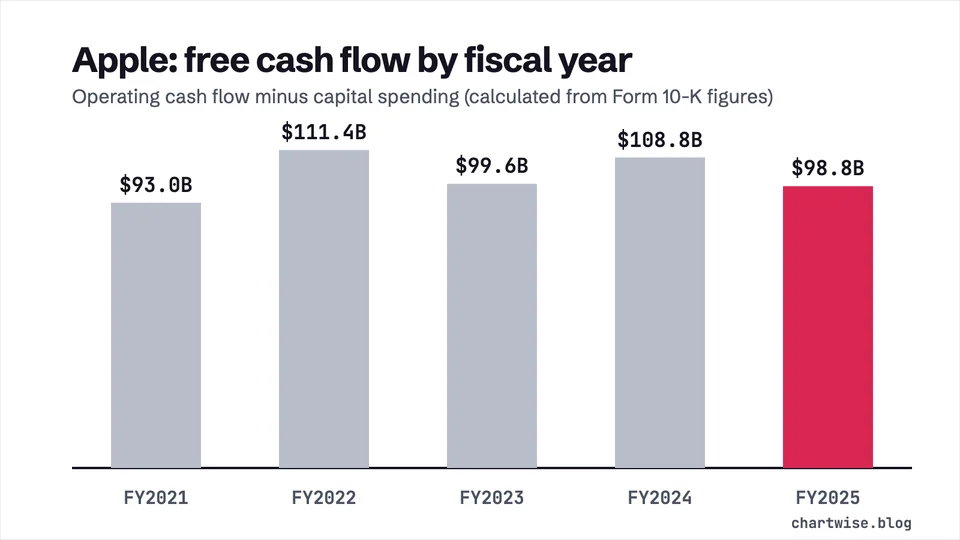
Using the typical formula, Apple's fiscal 2025 free cash flow was $98,767 million: $111,482 million of operating cash flow minus $12,715 million paid for property, plant and equipment (calculated from [4]). Microsoft shows how heavy investment changes the picture. In fiscal 2026 its operating cash flow rose to $182,935 million, but additions to property and equipment rose to $115,948 million [7], so free cash flow on the same formula was $66,987 million, down from $71,611 million a year earlier (calculated). See the Microsoft company page for the filing figures.
SEC staff also caution against implying that free cash flow is the cash left over for discretionary spending, because many companies have mandatory debt payments that the measure does not deduct [6]. With that caveat, compare it with what a company pays out. Apple's dividends and share repurchases in fiscal 2025 came to $106,132 million (calculated from [4]), 107.46% of its free cash flow on this formula (calculated). In the same year, maturities and sales of marketable securities exceeded purchases by $29,390 million (calculated from [4]). For how payouts work, read how dividends work.
Mistakes beginners make with cash flow statements#
- Treating net income as cash
Net income is a profit figure; the operating section reconciles it to the cash the company actually received or used [2].
- Reading a cash increase as success
Cash can rise because a company borrowed or sold investments. Selling stock or borrowing from banks is a financing inflow [2], so check which section the cash came from.
- Comparing free cash flow figures blindly
Free cash flow has no uniform definition [6]. Check how each company calculates it before comparing two numbers.
- Expecting free cash flow per share
SEC staff say free cash flow must not be presented on a per share basis [6]. If you see a per share figure, check who calculated it and how.
- Reading one statement alone
Cash flows link the other statements: Apple's ending cash on the cash flow statement equals the cash on its balance sheet [4] [5]. Read the balance sheet too.
Questions readers ask#
Where do I find a company's cash flow statement?
Why is operating cash flow different from net income?
The indirect method starts from net income and adjusts for items that did not affect cash, such as depreciation, and for changes in current assets and current liabilities such as receivables, inventory and payables [1].
Is negative cash flow from investing a bad sign?
What is the difference between the direct and indirect method?
Does strong cash flow mean the stock will go up?
No. The statement describes a past period, and share prices also reflect expectations. Nothing on this page is a recommendation to buy or sell any stock, and stocks can lose value.
In one paragraph#
Read a cash flow statement from top to bottom: operating cash first, compared with net income, then investing, then financing, then the change in cash and the ending balance. Calculate free cash flow yourself and check how any company figure is defined. Then put it next to the balance sheet and the income statement to see the whole company.
Sources
- What is a statement of cash flows?.
- Beginners' Guide to Financial Statements.
- How to Read a 10-K/10-Q | Investor.gov.
- CONSOLIDATED STATEMENTS OF CASH FLOWS (Apple Inc. Form 10-K for the fiscal year ended September 27, 2025, R8).
- CONSOLIDATED BALANCE SHEETS (Apple Inc. Form 10-K for the fiscal year ended September 27, 2025, R5).
- Non-GAAP Financial Measures (Compliance and Disclosure Interpretations).
- CASH FLOWS STATEMENTS (Microsoft Corporation Form 10-K for the fiscal year ended June 30, 2026, R6).
Education only. This page is not investment, tax or legal advice. Stocks can lose value. See our risk disclosure.