Explainer · Company Fundamentals
Book value and the price-to-book ratio
Book value is what the balance sheet says a company is worth to its shareholders. The price-to-book ratio compares that accounting figure with what the market pays for each share.
Quick answer
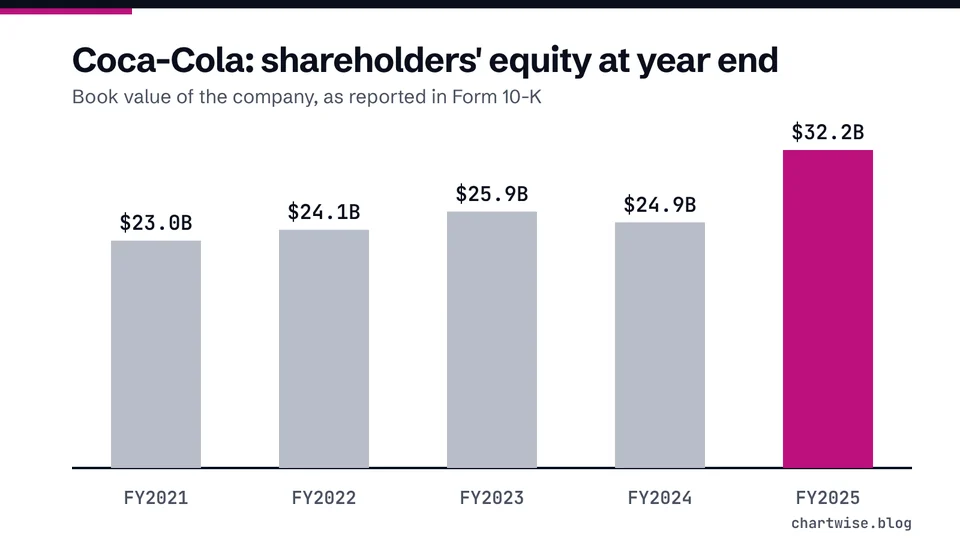
Book value is a company's total assets minus total liabilities, also called shareholders' equity [3]. Divide it by common shares outstanding to get book value per share. The price-to-book (P/B) ratio is the share price divided by book value per share [4].
Key points
- Book value = total assets minus total liabilities, the same number as shareholders' equity [3].
- Book value per share = book value / common shares outstanding; P/B = share price / book value per share [4].
- A P/B below 1 can reflect real problems, such as weaker prospects or lawsuit risk, that do not show up in book value [3].
- P/B is most useful for similar, asset-heavy companies and less meaningful where brands or intellectual property drive value [3].
- S&P Dow Jones Indices uses book value to price as one of three value factors in its U.S. style indices, not a verdict on its own [8].
On this page
What is book value?#
Every balance sheet follows one identity: assets equal liabilities plus shareholders' equity [1]. Rearrange it and equity is what is left of the assets once the liabilities are taken out. The accounting standard setter, the FASB, defines equity in exactly those terms: the residual interest in the assets of an entity after deducting its liabilities [2].
When investors talk about stocks, that residual is called book value. FINRA describes it as the accounting value of a company, total assets minus total liabilities, also called shareholders' equity, and as the theoretical net proceeds if the company were liquidated that day [3]. The word theoretical matters: book value is an accounting figure, not a price anyone has agreed to pay.
Real balance sheets show how different the mix can be. The figures below are from each company's Form 10-K, at the end of its latest fiscal year in our data.
| Company and year-end | Total assets | Total liabilities | Book value (equity) |
|---|---|---|---|
| Costco, Aug 31, 2025 | $77.099B | $47.935B | $29.164B |
| Apple, Sep 27, 2025 | $359.241B | $285.508B | $73.733B |
| Microsoft, Jun 30, 2026 | $758.376B | $315.989B | $442.387B |
| JPMorgan Chase, Dec 31, 2025 | $4,424.900B | $4,062.462B | $362.438B |
Assets, liabilities and stockholders' equity as reported in each Form 10-K (SEC XBRL data). B = billion. In each row assets minus liabilities equals the equity shown (calculated).
At JPMorgan Chase, liabilities were 91.81% of total assets; at Microsoft, 41.67% (calculated). Same formula, very different balance sheets. See the JPMorgan Chase and Microsoft pages for the filings.
How do you calculate book value per share?#
Book value is a total for the whole company. To compare it with a share price you need it per share. Nasdaq's definition of the price-book ratio uses common stockholder equity per share, adjusted for stock splits [4]. If a company also has preferred stock, the equity that belongs to preferred holders is not part of the common shareholders' book value, so check the balance sheet for it.
- Find total assets and total liabilities
Both are on the balance sheet in the company's Form 10-K or 10-Q. Use the same balance sheet date for both.
- Subtract
Assets minus liabilities gives book value, which the balance sheet usually labels total stockholders' or shareholders' equity.
- Find common shares outstanding
Use a share count as close as possible to the balance sheet date. The cover page of a 10-K gives the count as of the latest practicable date [5].
- Divide
Book value / common shares = book value per share. Then share price / book value per share = P/B.
- Total assets
- $500 millionhypothetical input for the calculated rows
- Total liabilities
- $300 millionhypothetical input for the calculated rows
- Book value
- $200 million$500M - $300M, calculated
- Shares outstanding
- 40 millionhypothetical input for the calculated rows
- Book value per share
- $5.00$200M / 40M, calculated
What is the price-to-book ratio?#
The price-to-book ratio, or P/B, is the current share price divided by book value per share [3]. Nasdaq describes it as comparing a stock's market value to the value of total assets less total liabilities [4]. Because price per share times shares is market capitalization [6], P/B also equals market cap divided by total book value (calculated).
Does a P/B below 1 mean a stock is cheap?#
Not on its own. FINRA notes that a stock might be considered undervalued if it trades below book value, then immediately adds that there can be other underlying reasons for it. The perception of weakening business prospects, or the risk of significant lawsuits, could send a stock price lower without affecting book value [3].
FINRA's value investing guidance makes the same point about both P/E and P/B: not every stock with a low P/E or P/B represents true value, and a stock might seem like a bargain while some market participants avoid it because they recognize reduced prospects [7]. A low P/B is a question to investigate, not an answer. Read the risk factors and the notes to the financial statements before drawing any conclusion.
When is book value less useful?#
FINRA says P/B is most useful when comparing similar companies, especially in asset-heavy industries like real estate and utilities. It calls book value less meaningful for companies with valuable brands or intellectual property, because those intangible assets, which can make up the bulk of market value, are often excluded from the calculation [3].
Book value can also be small next to profits. Apple's book value at the end of fiscal 2025 was $73.733 billion, while its net income for that fiscal year was $112.010 billion, as reported in its Form 10-K. Book value was about 65.83% of one year's net income (calculated). A P/B ratio says little about what such a business earns, so it helps to read it alongside measures like return on equity and the P/E ratio. See the Apple page for the filing.
How do index providers use book value?#
S&P Dow Jones Indices sorts stocks into its U.S. style indices with three value factors: book value to price, earnings to price and sales to price [8]. Book value to price is simply P/B turned upside down. The point for a beginner is that a professional index methodology uses book value as one of three value measures, alongside growth measures, not as a stand-alone signal [8].
FINRA likewise notes that which metrics qualify a stock as value is subjective, though they generally include a low P/E or a low P/B [7]. Try the P/E ratio calculator to see the earnings side of the same comparison.
Mistakes beginners make with book value#
- Treating a P/B below 1 as a bargain
FINRA lists weaker prospects and lawsuit risk as reasons a price can fall without book value changing [3]. Find out why the market disagrees with the balance sheet.
- Comparing P/B across unlike industries
A utility and a company whose value rests on brands or intellectual property are not comparable on book value. FINRA says the measure works best between similar, asset-heavy companies [3].
- Mixing dates
Dividing today's price by a book value from a balance sheet many months old, or by a share count from a different date, without saying so.
- Forgetting preferred stock
Per-share book value for common shareholders uses common stockholder equity [4]. Equity that belongs to preferred holders should not be in it.
- Reading book value as sale value
FINRA calls it the theoretical proceeds of a liquidation [3]. It is an accounting figure, not a price a buyer has agreed to pay.
Frequently asked questions#
Is book value the same as shareholders' equity?
Yes, for stocks the two terms are used for the same number: total assets minus total liabilities [3]. On a 10-K balance sheet look for total stockholders' or shareholders' equity.
What is a good price-to-book ratio?
There is no universal good level. FINRA says P/B is most useful when comparing similar companies [3], so compare a company with its peers and its own history, and read why the ratio is high or low.
Can book value be negative?
Yes. If total liabilities exceed total assets, assets minus liabilities is below zero (calculated from the definition). Book value per share is then negative, so a P/B ratio cannot be read in the usual way.
Where do I find the numbers?
Total assets, total liabilities and equity are on the balance sheet in the company's 10-K or 10-Q. All 10-Ks and 10-Qs are free on the SEC's EDGAR website [9].
The bottom line#
Book value tells you what the balance sheet says shareholders own after debts. P/B compares that with the market price. Use both to ask questions, not to reach verdicts: check the dates, the industry, any preferred stock and the reasons behind a low ratio, and pair P/B with earnings measures such as return on equity. Stocks can lose value whatever their P/B.
Sources
- Beginners' Guide to Financial Statements.
- Statement of Financial Accounting Concepts No. 8, Conceptual Framework for Financial Reporting, Chapter 4, Elements of Financial Statements.
- Defining the Value of an Investment.
- Price-Book Ratio.
- Form 10-K (SEC 1673 (02-25)).
- Market Capitalization.
- Value Investing.
- S&P U.S. Style Indices Methodology.
- How to Read a 10-K/10-Q | Investor.gov.
Education only. This page is not investment, tax or legal advice. Stocks can lose value. See our risk disclosure.