Explainer · Risk, Costs & Protection
Brokerage fees and hidden costs explained
A $0 commission does not mean a trade costs nothing. Here is every cost a beginner can meet when buying and selling U.S. stocks, where it shows up, and how to find it before you open an account.
Quick answer
Brokerage costs include commissions or markups on trades [5], small regulatory charges on sales that brokers generally pass to customers [2], the bid-ask spread, and account fees. Small ongoing fees can have a big impact over time [1].
Key points
- In a brokerage account you typically pay a commission or markup when you buy or sell [5].
- The bid-ask spread is a cost even when the commission is zero: on a hypothetical 100-share round trip with a $0.10 spread it is $10 (calculated).
- Since April 4, 2026 the SEC's Section 31 fee rate is $20.60 per million dollars of covered sales [6].
- Some market makers pay brokers for routing orders, which is called payment for order flow [10].
- Every broker must give you a Form CRS relationship summary, a starting point for its fees [5].
On this page
What fees can you pay when you buy and sell stocks?#
Trading costs come in two groups. Some are charged on each trade. Others are charged on the account, whether you trade or not. The table lists the main ones a beginner meets with an ordinary U.S. brokerage account, with the source for each definition.
| Cost | When you pay it | Where you see it |
|---|---|---|
| Commission | On a buy or sell through an agent | Trade confirmation |
| Markup or markdown | When the firm sells to or buys from you from its own inventory | Built into the price |
| Regulatory fees on sales | When you sell | May appear as a small line on the sale confirmation |
| Bid-ask spread | Every round trip, buy then sell | Gap between the bid and ask in the quote |
| Account and miscellaneous fees | For services such as transfers or paper mail | The firm's fee schedule |
Commission, markup and markdown definitions from the SEC [1]; regulatory fees [2]; bid and ask [3]; miscellaneous fee labels [4]. The last column describes where the cost usually appears and can vary by firm.
How do commissions and markups work?#
A commission pays the firm for acting as your agent. The SEC explains that you will often pay a commission when you buy or sell a security through an investment professional [1]. A markup or markdown is different. When a broker-dealer sells you a security from its own inventory, it acts as principal and is generally paid by selling to you above the market price (a markup) or buying from you below it (a markdown) [1]. A markup does not show up as a separate fee, so it is easy to miss.
FINRA sums up the brokerage model simply: you will typically pay a commission or markup when you buy or sell a security [5]. It adds that transaction-based fees may suit you if you do not trade often [5]. The reverse also holds. Each extra trade adds another set of costs.
What are the regulatory fees on stock sales?#
Two small charges apply to sales, not purchases. Under Section 31 of the Securities Exchange Act, each self-regulatory organization pays the SEC a fee based on the dollar amount of covered sales [2]. Starting April 4, 2026, the rate for most securities transactions is $20.60 per million dollars; it was $0.00 per million through April 3, 2026 [6]. That was still the SEC's latest Section 31 rate advisory when we checked in October 2026. The rate changes from time to time, so check the SEC's current fee rate advisory.
FINRA also charges its member firms a Trading Activity Fee on each sale of a covered stock. Its 2026 rate is $0.000195 per share, capped at $9.79 per trade, up from $0.000166 and $8.30 in 2025 [7]. FINRA has paused this fee for sales from October 1 through December 31, 2026 [8], and its published schedule raises the rate again in later years [7]. Section 31 itself puts no obligation on brokers or customers, but the SEC explains that self-regulatory organizations require their broker-dealer members to pay per-transaction charges, and brokers in turn generally charge their customers per-transaction charges [2].
- Section 31 charge at $20.60 per million
- $0.103$5,000 x 20.60 / 1,000,000, calculated with the rate in [6]
- FINRA fee at the 2026 rate of $0.000195 per share
- $0.0195100 x $0.000195, calculated with the rate in [7]; $0 for sales from Oct. 1 to Dec. 31, 2026 [8]
- Most the FINRA fee can be per trade in 2026
- $9.79[7]
These amounts come from the rates the rules set for firms. Your broker's confirmation may round them or show them differently, so the line you see can differ by a cent or two.
Is commission-free trading really free?#
A $0 commission removes one cost, not all of them. The bid is the highest price a buyer will pay and the ask is the lowest price a seller will accept; the gap is the spread [3]. If you buy at the ask and later sell at the bid, the spread comes out of your result. FINRA notes that illiquid investments often have wide spreads, and that large spreads can reduce returns by raising the buy price or lowering the sell price [9]. Our article on the bid-ask spread shows how to read it on a quote.
Brokers also earn money in ways you do not pay directly. Investor.gov explains that some market makers pay your broker for routing your order to them, perhaps a penny or more per share, which is called payment for order flow [10]. Your broker still has a duty to seek the best execution reasonably available for your order [10]. Price improvement, a fill better than the current quote, is an opportunity and not a guarantee [10].
How much do small ongoing fees add up over time?#
Ongoing fees are taken every year, so their effect builds over time. An investment adviser who manages your portfolio, for example, may charge an ongoing annual fee based on its value [1]. The SEC illustrates this with a $100,000 investment that grows 4% a year for 20 years [1]. In its chart, the ending value is approximately $208,000 with a 0.25% annual fee, $198,000 with 0.50% and $179,000 with 1.00% [1].
The SEC's own summary: over time, even small ongoing fees have a big impact on your investment portfolio [1]. Fund fees work the same way; see expense ratios explained and compare two fee levels in the fund fee calculator.
How do you find a broker's full list of fees?#
- Read the Form CRS
Brokerage firms and SEC-registered investment advisers must give prospective clients a customer relationship summary, Form CRS [5].
- Open the full fee schedule
Look for transfer, wire, paper statement and other service charges. The SEC notes miscellaneous fees go by many labels, such as clearing and transfer fees or administrative service fees [4].
- Check what uninvested cash earns
The terms of bank sweep programs can vary significantly, and they often pay less interest than money market fund sweeps [12].
- Ask about anything unclear
The SEC's advice is to ask your investment professional to explain all of the fees you will pay [1].
Mistakes beginners make with brokerage fees#
- Ignoring account fees
Transfer and service charges sit in the fee schedule, not on the trade ticket [4].
- Leaving cash idle without checking the rate
Bank sweep programs often pay less interest than money market fund sweeps [12]. Check which one holds your cash.
- Trading often to chase small moves
Each round trip pays the spread again. A small gain can turn into a loss after costs (see the worked example above).
Frequently asked questions#
Why is there a fee when I sell but not when I buy?
How do commission-free brokers make money?
Is the bid-ask spread a fee?
It is not billed as a fee, but it is a real cost of buying and then selling. FINRA notes large spreads can reduce returns [9].
The bottom line#
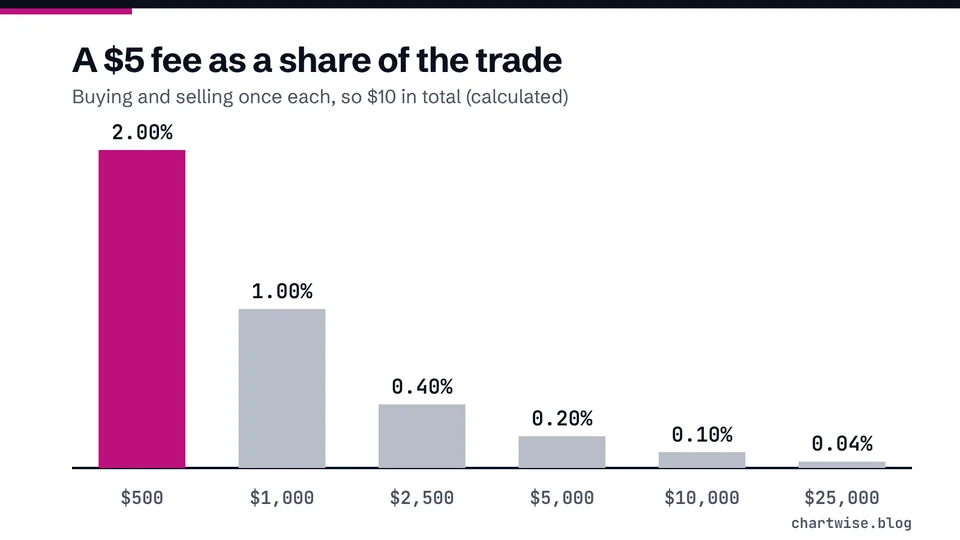
The headline commission is only one line of the bill. Before you open an account, read the Form CRS and the fee schedule, check what idle cash earns, and look at the bid-ask spread of anything you plan to buy. Count costs as a percentage of each trade and trade less often. Costs are certain; returns are not, as stock market risk explained shows. To understand what happens if the broker itself fails, read SIPC protection explained.
Sources
- How Fees and Expenses Affect Your Investment Portfolio.
- Section 31 Transaction Fees: Basic Information for Firms.
- Bid Price.
- Investor Bulletin: Brokers' Miscellaneous Fees.
- Brokerage and Advisory Accounts: Factors to Consider When Choosing an Account Type.
- Section 31 Transaction Fee Rate Advisory for Fiscal Year 2026.
- FINRA Fee Adjustment Schedule.
- Self-Regulatory Organizations; Financial Industry Regulatory Authority, Inc.; Notice of Filing and Immediate Effectiveness of a Proposed Rule Change to Temporarily Pause Assessment of the Trading Activity Fee (Release No. 34-106409).
- Understanding Market Liquidity and Your Investments.
- Executing an Order.
- Understanding Order Types | Investor.gov.
- Cash Sweep Programs for Uninvested Cash in Your Investment Accounts - Investor Bulletin.
Education only. This page is not investment, tax or legal advice. Stocks can lose value. See our risk disclosure.