Explainer · Stock Market Basics
Market orders vs limit orders for stocks
Every stock order answers one question first: do you care more about getting the trade done, or about the price you pay? Market and limit orders are the two basic answers.
Quick answer
A market order buys or sells at the best available price and usually fills right away, but the price is not guaranteed [1]. A limit order sets the worst price you will accept, so you get that price or better, but it may never execute [2].
Key points
- A market order trades for speed: it generally executes immediately, but the fill price can differ from the last price you saw [1].
- A limit order trades for price control: a buy limit fills only at or below your limit, a sell limit only at or above it [2].
- Brokerage firms typically treat an order as a market order unless you say otherwise, so check the order ticket before you press submit [2].
- A stop order turns into a market order once the stop price is reached, and in a fast market the fill can land well below the stop [3].
- Unless you choose otherwise, orders are usually day orders that expire at the end of the trading day [1].
On this page
What is the difference between a market order and a limit order?#
A market order is an order to buy or sell a stock at the best available price. It generally executes immediately, but the SEC notes that the price at which it executes is not guaranteed [1]. FINRA describes it as the most common type of investor order, and says brokerage firms typically enter your order as a market order unless you specify otherwise [2].
A limit order is an order to buy or sell at a specific price or better [1]. A buy limit order can execute only at or below the limit price, and a sell limit order only at or above it [2]. The trade-off is that a limit order is not guaranteed to execute: it can only fill if the market price reaches your limit [1].
So the choice is between two kinds of uncertainty. With a market order you know the trade will very likely happen, but not the exact price. With a limit order you know the worst price you will get, but not whether the trade will happen at all.
The table below sets the two side by side, with the stop order added because many order tickets show all three together.
| Question | Market order | Limit order | Stop order |
|---|---|---|---|
| What it does | Buys or sells at the best available price | Buys or sells at your price or better | Becomes a market order once a set price trades |
| Will it fill? | Generally right away | Only if the market reaches your limit | Only after the stop price is reached |
| Do you control the price? | No | Yes, you set the worst price | No, once triggered |
| Main risk | Fill differs from the price you saw | Order may never execute | Fill well past the stop in a fast market |
Sources: SEC Investor.gov [1], FINRA [2] [3].
Why can a market order fill at a different price than the quote?#
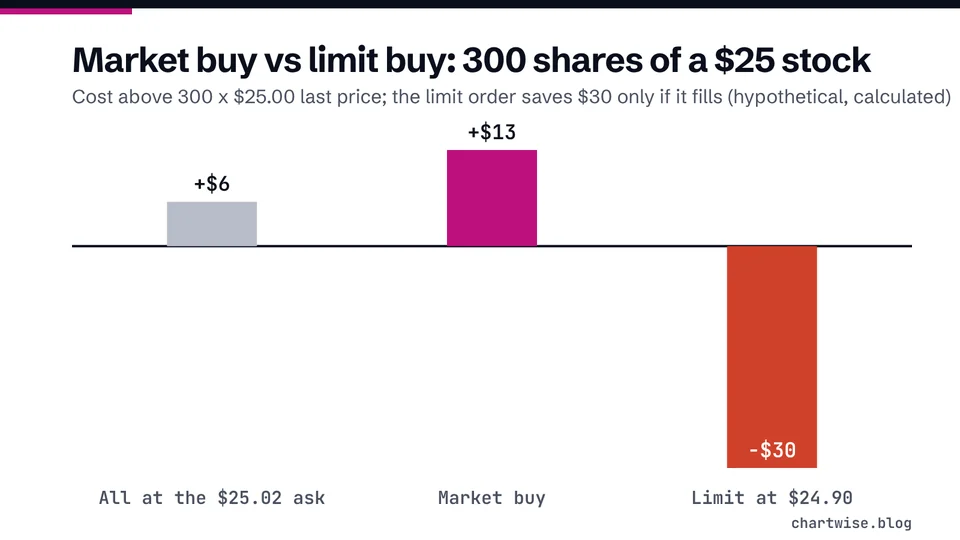
Because the price on your screen is a record of the past, and the order meets the market as it is a moment later. The SEC warns that the last-traded price is not necessarily the price at which a market order will be executed [1]. Fills often deviate from the last trade or the "real time" quote because of demand for the stock and the prices of available liquidity at that moment [1].
Size matters too. Parts of a large market order may execute at different prices if there are not enough shares offered at one price [1]. FINRA adds that a market order generally executes at or near the current bid or ask during normal trading hours, 9:30 a.m. to 4 p.m. Eastern Time, and that you might not get the price you saw, especially in fast-moving markets [2]. The gap between the bid and the ask is its own cost, covered in the bid-ask spread on a stock page.
- Last trade
- $25.00example
- Market order total
- $7,513.00100 x $25.02 + 100 x $25.04 + 100 x $25.07, calculated
- Average fill
- $25.0433calculated
- Limit order at $24.90
- $7,470.00 if filledcalculated; may not fill
When can a limit order fail to execute?#
Whenever the market does not come to your price. FINRA puts it simply: if the market price fails to match or better your limit while the order is active, it will not be executed [2]. A buy limit set well below the current ask, or a sell limit set well above the bid, can sit unfilled all day while the stock moves away from you.
There is also a quieter version of this risk. If only some shares trade at your price, you may get a partial fill. FINRA lists order qualifiers for this: all or none prevents partial fills, immediate or cancel fills as much as possible right away, and fill or kill executes the entire order immediately or not at all [4]. Not every broker offers every qualifier, so check what yours supports before you rely on one [2].
Some situations favor one type over the other. Some brokers allow only market orders for fractional shares [5]. Outside regular hours, FINRA notes that extended-hours trading may not be available for all order types and carries risks such as lower liquidity and higher volatility [4]. Our guide to pre-market and after-hours trading explains why spreads widen then.
How do stop and stop-limit orders fit in?#
A stop order, also called a stop-loss order, is an order to buy or sell once the stock reaches a specified price, the stop price [1]. FINRA spells out the key detail: a stop order becomes a market order once the stop price is reached [3]. That means it inherits the market order's main weakness.
FINRA's own example uses a $50 floor. When the stock reaches $50, the sell stop becomes a market order, and if the market is moving fast you could receive less, potentially significantly less, than $50 a share [3]. Suppose 100 shares of a hypothetical stock fill at $47.80 after a $50 stop triggers. That is $220.00 less than the stop price implied, a 4.4% gap (calculated). Rapid short-lived moves can also trigger a stop, after which the stock may rebound to its prior level [3].
A stop-limit order combines the two: the stop price triggers a limit order [2]. Shares then trade only if your firm can get the limit price or better [3]. As with any limit order, it may not execute if the price moves away from the limit [1]. In the example above, a stop at $50 with a limit at $49.50 would not have sold at $47.80, and the shares would still be held if the price kept falling.
How long does a stock order stay open?#
That depends on the time-in-force you choose. Unless you specify otherwise, orders to buy and sell a stock are day orders, good only during the trading day they are entered [1]. A good-til-canceled (GTC) order lasts until it is executed in full or canceled [1]. FINRA notes that brokerage firms typically set a limit on how many days GTC orders can stay active, often many months [4].
An open GTC limit order is easy to forget. If news moves the stock weeks later, the order can fill at a price you would no longer choose. Review open orders whenever you log in, and cancel the ones that no longer match your plan. Our walkthrough of how to buy your first stock shows where these settings sit on a typical order ticket.
- Check the order type field
Firms typically default to a market order unless you choose another type [2]. Make the choice on purpose.
- Look at the bid, ask and size
If few shares are offered at the ask, parts of a market order may fill at different, higher prices [1].
- Pick a limit price you would accept
For a buy, the limit is the most you will pay. For a sell, it is the least you will take [2].
- Choose the time-in-force
Day orders expire at the end of the trading day; GTC orders can stay open for months [4].
- Confirm the fill
After the trade, compare the fill price with what you expected and cancel any orders you no longer want.
Mistakes beginners make with market and limit orders#
- Assuming the last price is your price
The last-traded price is not necessarily the price a market order gets [1]. In the 300-share example, the order paid $13.00 more than the last price suggested (calculated).
- Sending a market order into a thin or fast market
FINRA warns that in fast-moving markets you might not get the price you saw [2]. A limit order caps the price you pay.
- Setting a limit far from the market and walking away
If the price never reaches your limit, nothing happens [2]. A limit that never fills is a missed trade, not a saved one.
- Treating a stop as a price floor
Once triggered, a stop is a market order and can fill well below the stop price [3].
- Forgetting open GTC orders
A GTC order lasts until filled or canceled [1], so an old order can execute long after your reason for placing it is gone.
Frequently asked questions#
Is a market order or a limit order better for beginners?
Neither is right for every trade. A market order favors getting the trade done; a limit order favors the price. FINRA warns that market orders may not get the price you saw in fast-moving markets, while a limit order may not execute at all [2]. Decide which risk matters more for that trade.
Can a limit order fill at a better price than my limit?
Yes. A limit order executes at your limit price or better, so a buy limit can fill below the limit and a sell limit above it [2].
What happens to my limit order at the end of the day?
Do market and limit orders cost different commissions?
It depends on the firm. FINRA suggests asking your brokerage firm what types of orders you can place and what they cost [2].
The bottom line#
A market order buys certainty of execution; a limit order buys certainty of price. Stop orders add a trigger but still become market orders once hit, and stop-limit orders can leave you holding shares in a fast decline. Whichever you use, read the bid, ask and size first, choose the time-in-force deliberately, and remember that no order type protects you from the stock itself losing value. Next, see how stock exchanges work to learn where your order goes after you press submit.
Sources
Education only. This page is not investment, tax or legal advice. Stocks can lose value. See our risk disclosure.