Glossary
Short selling
Most investors buy first and sell later. A short seller does it the other way round, and that flips the risk: the gain is capped, the loss is not.
Short selling is selling a stock you do not own, usually shares borrowed for delivery, in the hope of buying it back later at a lower price. If the price rises instead, you lose money.
Quick answer
Short selling is the sale of a stock you do not own, or that you will borrow for delivery [1]. If the price drops, you buy back lower and profit; if it rises, you lose [2]. Because a price can keep rising, the SEC warns that losses can be unlimited [1].
Key points
On this page
How does short selling work?#
The SEC defines a short sale as generally the sale of a stock you do not own, or that you will borrow for delivery [1]. Investors who sell short believe the price will fall. If it does, they can buy the stock back at the lower price and keep the difference as profit; if the price rises and they buy back higher, they take a loss [2].
Before effecting a short sale order, Regulation SHO requires a broker-dealer to have reasonable grounds to believe the shares can be borrowed so they can be delivered when due, often called the locate requirement [1]. A "naked" short sale is one where the seller does not borrow or arrange to borrow the shares in time to deliver them within the standard settlement period [1].
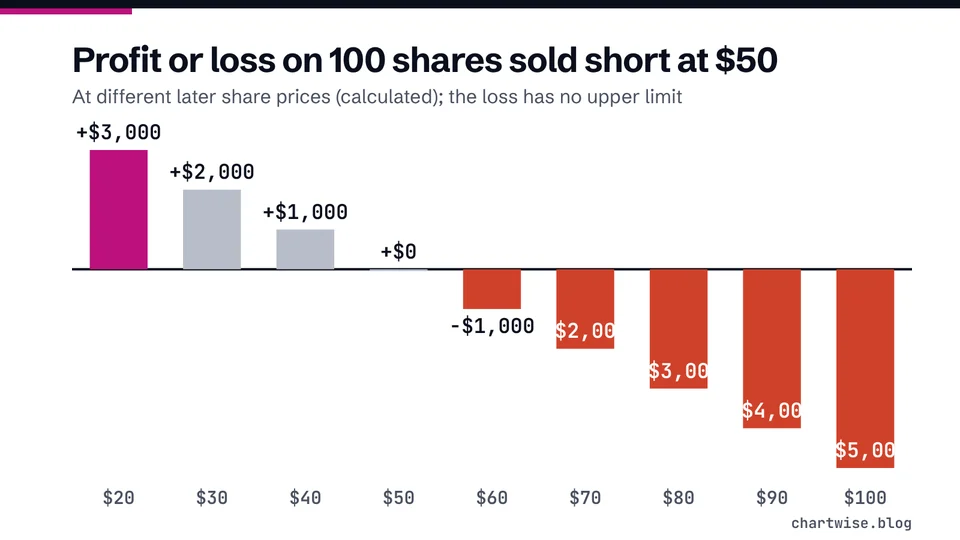
Here is how the result changes with the price for a hypothetical short sale of 100 shares at $50.
| Price when you buy back | Result on 100 shares |
|---|---|
| Falls to $40 | +$1,000 |
| Rises to $60 | -$1,000 |
| Rises to $70 | -$2,000 |
| Rises to $100 | -$5,000 |
Hypothetical short sale of 100 shares at $50; results calculated before borrowing costs, interest and commissions.
Why can short selling losses be unlimited?#
When you buy a stock, the worst case is that it falls to zero and you lose what you paid. The SEC points out that with a traditional long position, risk is limited to the amount invested, while shorting a stock leaves an investor open to the possibility of unlimited losses [1]. There is no ceiling on how high a price can go, so there is no ceiling on what it can cost to buy the shares back [1].
A short sale usually involves borrowed shares [1], and borrowing changes the risk. Our guide to the pattern day trader rule and margin explains how margin accounts work, and why the SEC says you can lose more money than you invested [3]. A brokerage account set up for margin is a different thing from a plain cash account. For how sharp price moves can be, see volatility.
Frequently asked questions#
Is short selling legal?
Yes, short sales are a regulated activity. The SEC's Regulation SHO sets rules for them, including the requirement that a broker have reasonable grounds to believe the shares can be borrowed before effecting the order [1].
What is naked short selling?
It is a short sale where the seller does not borrow or arrange to borrow the shares in time to deliver them within the standard settlement period [1].
Should beginners short stocks?
Shorting reverses the usual risk: the gain is limited to the sale price, while the SEC warns the possible loss is unlimited [1]. Understand margin and read our risk disclosure before considering it.
The bottom line#
Short selling means selling first and buying back later, betting on a lower price. The trade-off is lopsided: the most you can gain is the sale price, while a rising price can cost you without limit. Learn how margin works first.
Sources
Education only. This page is not investment, tax or legal advice. Stocks can lose value. See our risk disclosure.