Explainer · Risk, Costs & Protection
The pattern day trader rule and margin accounts
For years, the pattern day trader rule told US investors they needed $25,000 to day trade on margin. In 2026 FINRA replaced it, but your broker may still apply the old rule until late 2027.
Quick answer
The pattern day trader rule required $25,000 from margin customers making four or more day trades in five business days, if over 6% of their trades [1]. FINRA replaced it effective June 4, 2026, but firms may phase in the change until October 20, 2027 [3].
Key points
- Under the old rule, four or more day trades in five business days could make you a pattern day trader who needed at least $25,000 [1].
- FINRA's new intraday margin standards removed the trade count and the $25,000 minimum, effective June 4, 2026 [3].
- Your firm may keep using the old rules during a transition that runs through October 20, 2027, so ask your broker which applies [4].
- Margin still needs at least $2,000 in equity, and firms can set higher requirements [4].
- Borrowing to trade can make you lose more money than you invested [7].
On this page
What was the pattern day trader rule?#
The pattern day trader rule was part of FINRA's margin rules. Investor.gov defines a pattern day trader as any customer who executes four or more day trades within five business days, provided those day trades are more than six percent of the customer's total trades in the margin account over the same five business days [1]. Investor.gov describes day traders as people who rapidly buy, sell and short-sell stocks throughout the day, holding shares for seconds or minutes [2].
Once a firm designated you a pattern day trader, you had to keep at least $25,000 in your account and could day trade only in a margin account [1]. That $25,000 figure is the number most beginners remember, and it is the part that changed in 2026.
Here is how the six percent test worked for two hypothetical traders who each made four day trades in the same five business days. "All trades" counts every trade in the margin account over those five days.
| Hypothetical trader | Day trades | All trades | Day trade share | Pattern day trader under old rule? |
|---|---|---|---|---|
| Trader A | 4 | 10 | 40% | Yes, above 6% |
| Trader B | 4 | 80 | 5% | No, not above 6% |
Shares calculated (4 / 10 and 4 / 80). Test and thresholds from Investor.gov [1].
What changed in 2026?#
On April 14, 2026, the SEC approved FINRA's rule filing SR-FINRA-2025-017 [3]. FINRA then published Regulatory Notice 26-10 on April 20, 2026, saying it had adopted new intraday margin standards to replace in their entirety the old day trading margin requirements, including the day trade count used to label someone a pattern day trader and the $25,000 minimum equity requirement [3].
The amendments took effect on June 4, 2026 [3]. Firms that need more time may phase in the change over 18 months, until October 20, 2027 [3]. FINRA's investor guide says plainly that your firm might keep operating under the old day trading margin requirements during the transition, or move to the new system sooner [4]. So as of October 2026, whether the $25,000 rule still affects you depends on your broker.
How does the new intraday margin standard work?#
Instead of counting your trades, the new standard looks at whether your account has enough equity to cover the positions you open during the day. If it does not, FINRA says you have an intraday margin deficit that you are expected to satisfy as promptly as possible [4]. You can do that by depositing funds or by closing positions [5].
Firms can check this in different ways. FINRA notes that a firm may monitor margin accounts in real time and block trades that would create a deficit, compute the requirement at the end of the day and then call for margin, or combine both approaches [4].
- A deficit appears
During the day your open positions need more margin than your account equity covers [4].
- Your firm asks you to fix it
You are expected to deposit funds or close positions as promptly as possible [5].
- The five business day line
If you make a practice of not meeting deficits promptly and one is still unmet at the close of the fifth business day, your firm must act [3].
- A 90-day restriction
The firm must stop you from creating or increasing a short position or debit balance for 90 calendar days, or until the deficit is satisfied [3].
How does a margin account work?#
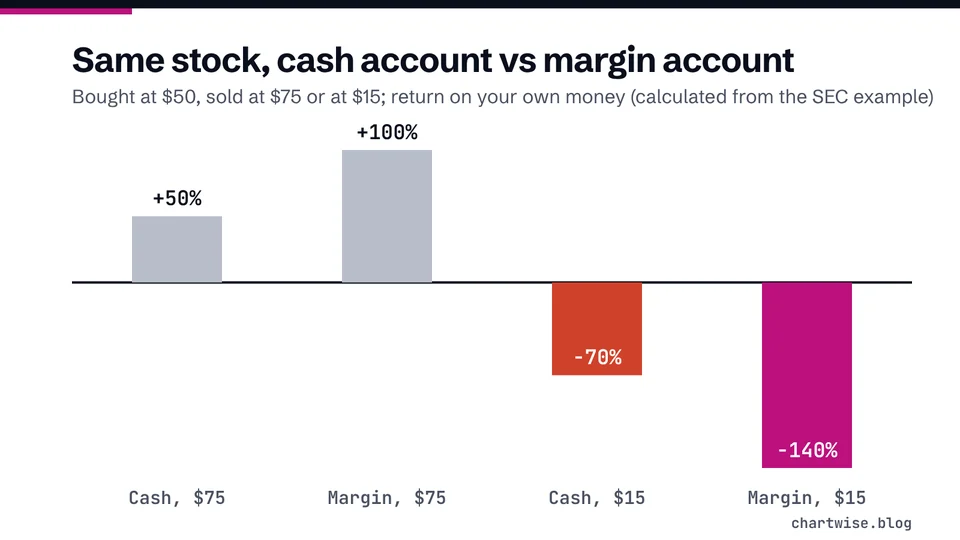
A margin account is a type of brokerage account in which the firm lends you cash, using your account as collateral, so you can buy securities [6]. Margin increases your purchasing power but also exposes you to larger losses [6].
The 2026 change targeted the day trading requirements [3]. The basic margin limits are set out in the SEC's 2021 margin bulletin: under the Federal Reserve Board's Regulation T, you may borrow up to 50 percent of the purchase price of margin securities [7]. FINRA's maintenance requirement is at least 25 percent of the market value of the securities, and many firms set higher house requirements, typically 30 to 40 percent [7]. If your equity falls below your firm's requirement, the firm generally makes a margin call [7].
Two details surprise many beginners. Your broker may be able to sell your securities at any time without consulting you first, and you are not entitled to choose which ones it sells [7]. And like all loans, margin loans charge interest, which directly reduces your return [7].
How fast can losses grow on margin?#
Take a hypothetical $10,000 stock purchase: $5,000 of your own cash and $5,000 borrowed, the most Regulation T allows [7]. The loan stays the same while the stock moves, so every drop in price comes out of your $5,000 first. The table shows your equity as a share of the position value, and how much of your own $5,000 is gained or lost. The figures ignore interest and fees.
| Stock price change | Position value | Your equity | Equity share | Your cash |
|---|---|---|---|---|
| Price down 10% | $9,000 | $4,000 | 44.44% | -20% |
| Price down 20% | $8,000 | $3,000 | 37.50% | -40% |
| Price down 30% | $7,000 | $2,000 | 28.57% | -60% |
| Price down 50% | $5,000 | $0 | 0% | -100% |
| Price down 60% | $4,000 | -$1,000 | below zero | -120% |
Hypothetical $10,000 purchase with $5,000 borrowed; all values calculated, interest and fees ignored.
This is why the SEC bulletin warns that you can lose more money than you have invested [7]. For a wider view of how prices swing, see volatility and our guide to stock market risk.
Does the rule change make day trading less risky?#
No. The change is about how firms measure margin, not about the odds of making money. FINRA's own investor guide says frequent trading with margin remains risky and that you should only use money you can afford to lose [4]. The SEC's long-standing warning is blunt: day traders typically suffer severe financial losses in their first months of trading, and many never graduate to profit-making status [8]. Day traders also pay their firms large amounts in commissions, training and equipment [8].
A lower entry bar can make it easier to start, which is not the same as making it safer. Firms can still impose requirements higher than FINRA's minimums [4].
Mistakes beginners make with the pattern day trader rule and margin#
- Assuming the $25,000 rule is gone at every broker
The new standard took effect June 4, 2026, but firms may keep the old rules until October 20, 2027 [4]. Check with your own firm.
- Treating buying power as your money
Margin buying power is a loan with interest [7]. A 50% drop on a fully margined purchase erases your entire stake (calculated).
- Ignoring intraday deficits
Repeatedly leaving deficits unmet can lead to a 90-day freeze on margin trading [5].
- Expecting to choose what gets sold
In a margin call your firm decides which securities to sell, and it may not ask first [7].
- Reading lower requirements as permission
FINRA still calls frequent margin trading risky [4]. Learn how orders work and what protections you have before trading often.
Frequently asked questions#
Is the $25,000 pattern day trader rule gone?
What is the minimum to trade on margin now?
What happens if I cannot cover an intraday margin deficit?
Does a cash account use margin?
No. In a cash account you must pay the full amount for the securities you buy, while a margin account lets you borrow from your firm [9]. Ask your broker how its trading rules apply to cash accounts.
The bottom line#
The pattern day trader rule's trade count and $25,000 minimum were replaced by FINRA's intraday margin standards on June 4, 2026, with a transition for firms until October 20, 2027. The margin basics did not change: you borrow, you pay interest, and a fall in price hits your own money first. Before using margin, ask your broker which rules it applies, run the numbers on a drop of 30% or 50%, and read about brokerage fees and costs.
Sources
- Pattern Day Trader | Investor.gov.
- Day Trading.
- Regulatory Notice 26-10: FINRA Adopts New Intraday Margin Standards to Replace the Day Trading Margin Requirements.
- Understanding the New Intraday Margin Requirements.
- Day Trading.
- Margin Account | Investor.gov.
- Investor Bulletin: Understanding Margin Accounts.
- Day Trading: Your Dollars at Risk.
- Investor Bulletin: How to Open a Brokerage Account.
Education only. This page is not investment, tax or legal advice. Stocks can lose value. See our risk disclosure.