Glossary
Stop-limit order
A stop-limit order fixes the main weakness of a plain stop order, the risk of a bad fill, by adding a price floor or ceiling. The cost is that the order may not fill at all.
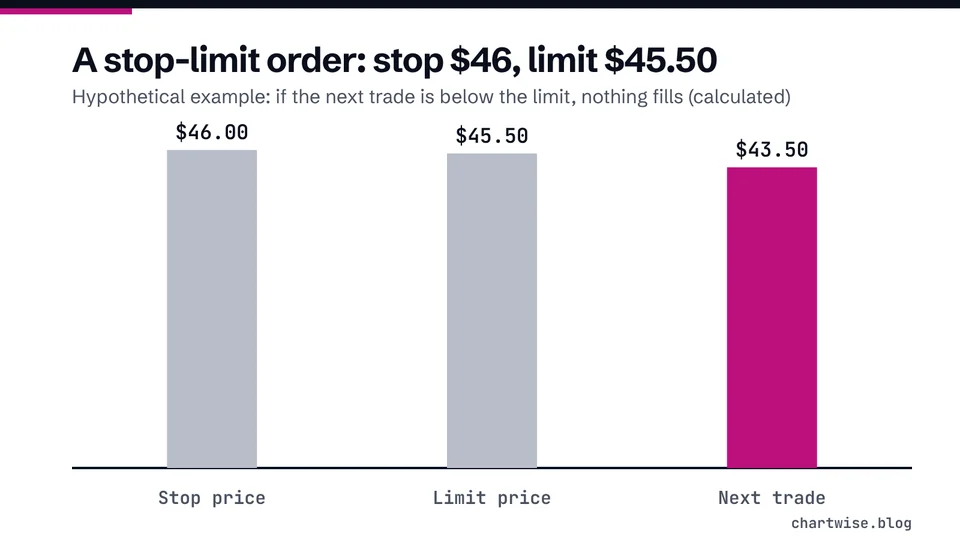
A stop-limit order combines a stop order and a limit order. When the stock reaches the stop price, it becomes a limit order that only executes at the limit price or better.
Quick answer
A stop-limit order combines a stop order and a limit order: once the stop price is reached, it becomes a limit order [1]. It will only fill at your limit price or better, so it may not be executed if the price moves away from the limit [1].
Key points
On this page
How does a stop-limit order work?#
The SEC describes a stop-limit order as an order that combines the features of a stop order and a limit order; once the stop price is reached, it becomes a limit order [1]. FINRA puts it this way: instead of the stop triggering a market order, your stop is designed to trigger the activation of a limit order [2].
The SEC gives an example: a sell stop-limit order with a stop price of $3.00 may have a limit price of $2.50 [1]. When the stock trades at $3.00, your order becomes a limit order to sell at $2.50 or better. For how limit orders behave on their own, see market orders vs limit orders.
| Order type | After the stop price is reached | Main risk |
|---|---|---|
| Stop order | Becomes a market order | Fill can be far from the stop price |
| Stop-limit order | Becomes a limit order | Order may not be executed |
From the SEC investor bulletin on stop and stop-limit orders [1].
Why might a stop-limit order never fill?#
Because a limit order only executes at the limit price or better. The SEC warns that a stop-limit order may not be executed if the stock's price moves away from the specified limit price [1]. FINRA adds that if the market price fails to match or better your limit price while your order remains active, it will not be executed [2].
That is the trade-off against a plain stop order. A triggered stop order becomes a market order, which generally executes immediately but at a price that is not guaranteed [3]. A stop-limit order protects the price but can leave you still holding shares that keep falling.
Frequently asked questions#
What is the difference between a stop order and a stop-limit order?
How far apart should the stop and limit prices be?
Do all brokers offer stop-limit orders?
FINRA suggests asking your brokerage firm which order types you can place and what they cost [2].
The bottom line#
A stop-limit order adds a price limit to a stop order. You avoid selling far below your plan, but you accept the risk that the order never fills while the price keeps moving. Decide which risk matters more before choosing it over a plain stop order, and read our guide to stock market risk.
Sources
Education only. This page is not investment, tax or legal advice. Stocks can lose value. See our risk disclosure.