Glossary
Stop order
A stop order is a trigger, not a price promise. It wakes up when the stock touches your stop price and then sells or buys at whatever the market offers.
A stop order, also called a stop-loss order, is an order to buy or sell a stock once its price reaches a level you set, the stop price. At that point it becomes a market order.
Quick answer
A stop order, or stop-loss order, is an order to buy or sell once a stock reaches a set price, the stop price [1]. When the stop price is reached it becomes a market order, so the fill can differ from the stop, especially in a fast-moving market [3].
Key points
On this page
How does a stop order work?#
You choose a stop price. A sell stop order is entered below the current market price, and a buy stop order above it [1]. Nothing happens until the stock trades at the stop price. Then the order becomes a market order [1], and FINRA says it is executed as soon as possible at the current market price [2].
Investor.gov notes one advantage: you don't have to watch the stock every day [3]. FINRA adds that you can generally use sell-stop orders to limit a loss or protect a profit [2]. If you want to compare it with other order types, see market orders vs limit orders.
| Order | Where the stop price goes | What happens when it is reached |
|---|---|---|
| Sell stop | Below the current market price | Becomes a market order to sell |
| Buy stop | Above the current market price | Becomes a market order to buy |
From the SEC investor bulletin on stop orders [1].
Why can a stop order fill at a worse price?#
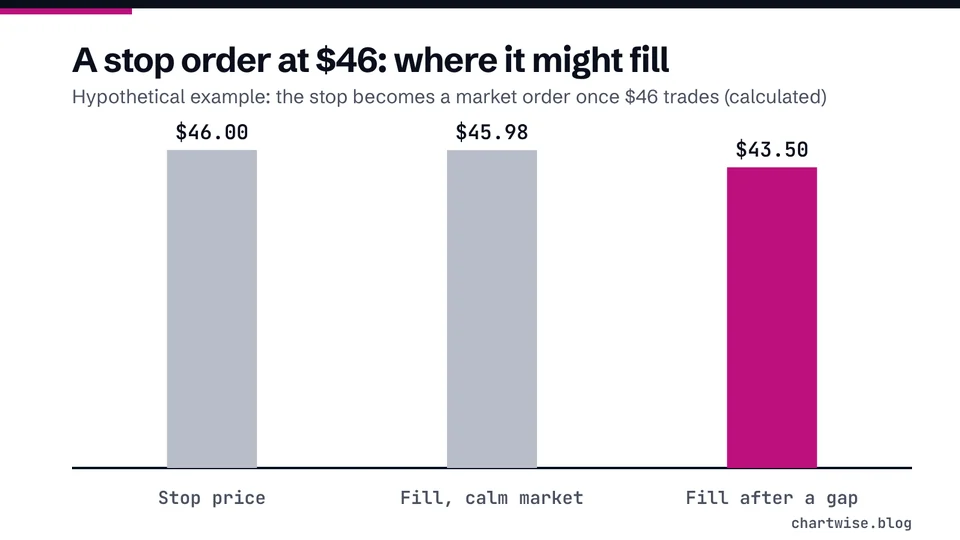
Because a market order takes the best price available at that moment, not the price you wrote down. The SEC says the stop price is not the guaranteed execution price for a stop order, and the execution price can deviate significantly from the stop price [1]. FINRA's example: with a sell stop at $50, in a fast market you could receive significantly less than $50 per share [4].
A second risk is being stopped out by noise. A short-term, intraday price move can trigger a stop order and lead to an execution price that is substantially worse [1], and the stock might later rebound to its prior level [4]. Our volatility entry explains how the size of those swings is measured.
Frequently asked questions#
Is a stop order the same as a stop-loss order?
Yes. The SEC says a stop order is also referred to as a stop-loss order [1].
Does a stop order guarantee my price?
No. Once triggered it becomes a market order, and the SEC says the stop price is not the guaranteed execution price [1]. If you need a price floor, a stop-limit order sets one, but it may not fill at all.
Can every broker take stop orders?
FINRA suggests asking your brokerage firm what types of orders you can place and what they cost [2].
The bottom line#
A stop order waits for your stop price and then becomes a market order. That makes it useful for limiting losses without watching the screen, but it does not lock in a price, and a quick dip can trigger it. Compare it with a stop-limit order before choosing.
Sources
Education only. This page is not investment, tax or legal advice. Stocks can lose value. See our risk disclosure.