Explainer · Dividends & Income
Dividend reinvestment plans (DRIPs) explained
A dividend reinvestment plan uses each dividend to buy more shares instead of paying you cash. It is simple to switch on, but it changes your tax records, your costs and how much of your money sits in one stock.
Quick answer
A dividend reinvestment plan (DRIP) uses your cash dividends to buy more shares of the same company [2]. You still owe tax on the reinvested dividends [9], plans may charge fees [2], and the shares can lose value like any stock.
Key points
- In a DRIP, dividends buy more of the company's stock instead of being paid to you in cash [2].
- Plans may charge fees and may set minimums; direct stock plans usually buy at set times at an average price, not a price you choose [2].
- Reinvested dividends are still reported as dividends for tax [9], so you can owe tax without receiving cash [4].
- Reinvesting compounds the number of shares you own, but it cannot protect you if the price falls or the dividend is cut [7].
- Every reinvestment is a purchase with its own cost, which matters when you later sell [11].
On this page
What is a dividend reinvestment plan?#
A dividend is a portion of a company's profit paid to shareholders [1]. Normally it lands in your account as cash. In a dividend reinvestment plan, or DRIP, you choose a different path: instead of receiving cash dividends, you buy more of the company's stock by having the dividends reinvested [2].
The SEC's investor site describes DRIPs together with direct stock plans, where some companies let you buy or sell stock directly from them without using or paying commissions to a broker [2]. Your brokerage firm may also have a reinvestment plan; check with the firm or the company whether you will be charged, and read the disclosure documents before you enroll [2]. Either way, the idea is the same: the cash goes straight back into shares of the company that paid it.
How does a DRIP work, step by step?#
You first need to be entitled to the dividend, which means owning the shares before the ex-dividend date [3]. After that, the plan does the work on its own schedule.
- Enroll the shares
Sign up through the company's plan, or through your broker if it offers reinvestment. Some plans require a minimum investment [2].
- Choose full or partial reinvestment
Some plans let you reinvest all dividends or take part in cash. One real plan prospectus offers both options [4].
- The plan buys on its own dates
Investor.gov says direct stock plans usually buy at established times, such as daily, weekly or monthly, at an average market price, not at a price you pick [2]. Your plan's terms say when it buys.
- Fractions are credited
A dividend rarely buys a whole number of shares. You may be able to invest a dollar amount rather than pay for a whole share [2].
- Keep the statements
Each purchase has its own date and price. You need these for tax, as explained below.
Fractional shares are not second-class: the SEC notes that owners of fractional shares still receive dividends and take part in corporate actions such as splits [5]. That is what lets a DRIP keep compounding even when each dividend is small.
How much can reinvesting add over time?#
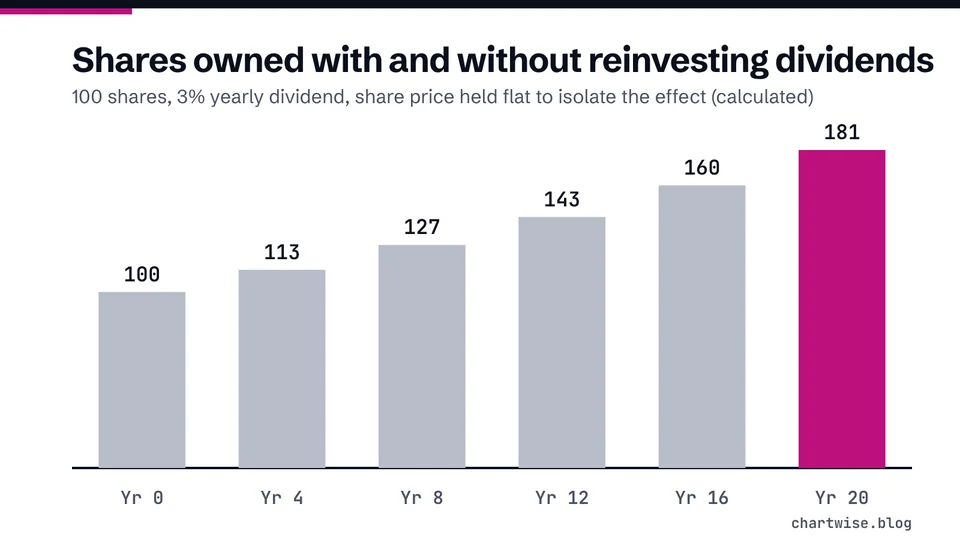
Reinvesting works like compound interest, which the SEC defines as interest paid on principal and on accumulated interest [6]. Each reinvested dividend buys shares, and those shares earn the next dividend. The effect is easiest to see with a simple, unrealistic assumption: a price that never moves.
The same example at three points in time, with the price held at $50.00:
| Point in time | DRIP shares | DRIP value | Cash route | Gap |
|---|---|---|---|---|
| After year 1 | 104.06 | $5,203.02 | $5,200.00 | $3.02 |
| After year 5 | 122.02 | $6,100.95 | $6,000.00 | $100.95 |
| After year 10 | 148.89 | $7,444.32 | $7,000.00 | $444.32 |
Hypothetical company, calculated. Cash route = 100 shares at $50.00 plus dividends collected, with no interest on the cash. Real prices move every day, so real results will differ.
Two points keep this honest. First, the gap grows slowly and only matters over many years. Second, the price never stays flat. Stock prices fluctuate daily and over longer periods, sometimes dramatically [7], and a DRIP keeps buying through falls as well as rises. Index providers track the same idea at a larger scale: an S&P total return index reinvests dividend income in the index, while a price index reflects only changes in stock prices [8]. See total return for how to measure it, or try your own assumptions in the compound growth calculator.
What does a DRIP cost?#
Buying directly from a company can avoid broker commissions, but the SEC warns that you may have to pay a fee for using the plan's services [2]. Terms differ from plan to plan, so the only reliable answer is the plan's own prospectus or your broker's fee schedule.
As an illustration only, here is what one real plan prospectus filed with the SEC says. It is a single company's plan from 2021, not a typical or current one.
Notice the price line. In this plan, shares bought from the company are priced at an average of the day's high and low on the payment date [4], and direct stock plans in general usually buy at set times at an average price [2], so you cannot choose the exact price or moment of purchase. For a long-term holder that is often acceptable; for anyone who cares about the entry price, it is a real limit.
Are reinvested dividends taxed?#
Yes. In a taxable account, reinvesting does not make a dividend disappear for tax purposes. The IRS instructions for Form 1099-DIV tell payers to include reinvested dividends in the total ordinary dividends they report [9], and you should receive a Form 1099-DIV from each payer for distributions of at least $10 [10].
The plan prospectus above spells out the practical problem: participants are treated as having received a dividend on the payment date, which may create a tax bill without providing cash to pay it [4]. In the worked example, the first year's reinvested dividends add up to $203.02 (calculated), all of it reportable even though none of it reached your bank account.
What are the risks of reinvesting automatically?#
A DRIP is a method, not a protection. The prospectus quoted above says it directly: your investment in the plan is not protected from losses [4]. Three risks stand out.
The dividend can shrink or stop. A company may pay dividends on common stock but does not have to, and it can cut or eliminate them [7]. A DRIP then simply has less, or nothing, to reinvest.
The position grows on its own. Every reinvestment adds to the same company, so over time more of your money can end up in one stock without you deciding it. Check the weight of each holding at least once a year.
The price is not yours to choose. Purchases happen on the plan's schedule; in the plan above, at the average of the day's high and low on the payment date [4]. That can include buying right after a sharp rise.
Mistakes beginners make with DRIPs#
- Assuming reinvested dividends are tax-free
They are still reported as dividends [9]. Set money aside for the tax in a taxable account.
- Throwing away the statements
Each reinvestment is a purchase with its own basis [11]. Without the records, working out your gain later is hard.
- Ignoring plan fees
Plans may charge for their services [2]. Small fees on small quarterly purchases can take a noticeable share.
- Reinvesting on autopilot forever
A dividend can be cut [7] and a single position can grow too large. Review the holding, not just the payments.
Frequently asked questions#
Do I need a broker to join a DRIP?
Not always. Some companies let you buy or sell stock directly from them without a broker [2], though they may charge plan fees. If your broker offers automatic reinvestment, the firm sets those terms.
Do I get a discount on DRIP shares?
Only if the plan offers one. One real prospectus says the company may offer a discount of between 0% and 5% on reinvested dividends [4]. Whether there is a discount depends on the plan, so read the terms.
Can I reinvest only part of my dividends?
Some plans allow it. The prospectus cited above offers full or partial reinvestment, with the rest paid in cash [4]. Check your own plan or broker.
Is a DRIP the same as total return?
No. A DRIP is a way to reinvest. Total return is a measure that adds income such as dividends to the change in value [12]. Reinvesting affects what your total return looks like over time.
The bottom line#
A DRIP turns each dividend into more shares, and over many years that compounding can add up. It does not avoid tax, it can carry fees, it buys at prices you do not choose, and it keeps adding to one company even when its outlook changes. Read the plan terms, keep every statement, and review the position once a year. Start with how dividends work, and read the risk disclosure before choosing any stock for its dividend.
Sources
- Dividend.
- Direct Investment Plans: Buying Stock Directly from the Company.
- Ex-Dividend Dates: When Are You Entitled to Stock and Cash Dividends.
- Franklin BSP Realty Trust, Inc. Amended and Restated Dividend Reinvestment and Direct Stock Purchase Plan, prospectus (Form 424B3).
- Fractional Share Investing - Buying a Slice Instead of the Whole Share.
- Compound Interest.
- Stocks.
- S&P Dow Jones Indices: Index Mathematics Methodology (September 2026).
- Instructions for Form 1099-DIV (01/2024).
- Topic no. 404, Dividends and other corporate distributions.
- Topic no. 703, Basis of assets.
- Evaluating Performance.
Education only. This page is not investment, tax or legal advice. Stocks can lose value. See our risk disclosure.