Glossary
Bear market
A bear market is the label for a deep, broad fall in stock prices. Knowing the definition helps you read the news; knowing the recovery math helps you understand why it hurts.
A bear market is a period when stock prices are falling and investors are pessimistic. The SEC's investor site says it generally means a broad market index falling 20% or more over at least two months.
Quick answer
A bear market is a time when stock prices are declining and sentiment is pessimistic. Generally it means a broad market index has fallen 20% or more over at least a two-month period [1]. FINRA calls a reversal of at least 10% before the previous trend resumes a correction [2].
Key points
- Investor.gov's rough rule: a broad index down 20% or more over at least two months [1].
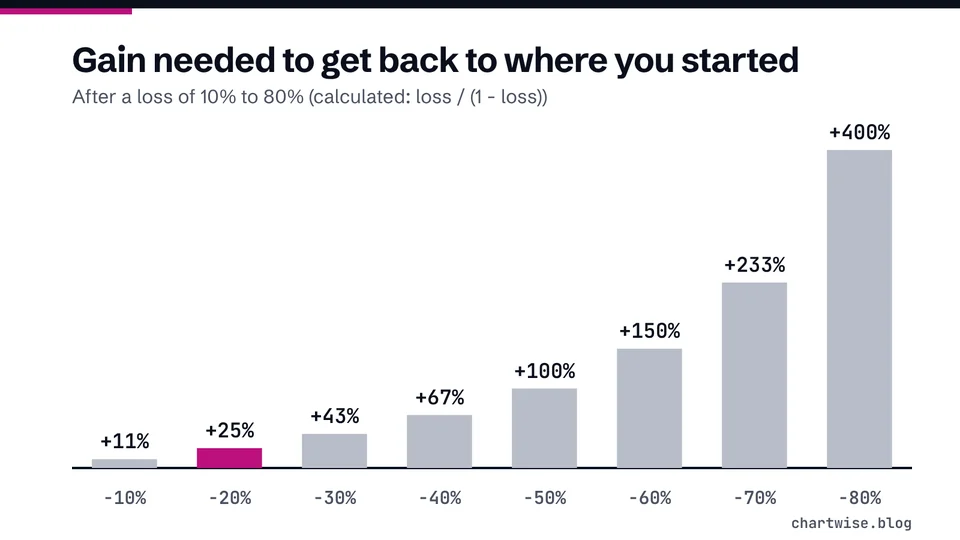
- A fall needs a bigger gain to recover: after a 34% drop, the index must rise 51.52% to get back (calculated).
- None of the sources we cite names an official body that declares a bear market; the CFTC glossary simply describes prices generally declining over months or years [3].
On this page
What does bear market mean?#
Investor.gov, the SEC's site for individual investors, defines a bear market as a time when stock prices are declining and market sentiment is pessimistic. Generally, it occurs when a broad market index falls by 20% or more over at least a two-month period [1]. FINRA uses the same 20% threshold for a broad market index [2].
The CFTC's glossary gives no number: a bear market is one in which prices generally are declining over a period of months or years [3]. FINRA calls a reversal of at least 10% followed by a return to the previous trend a market correction [2].
| Term | Typical size of the move | Source |
|---|---|---|
| Correction | A reversal of at least 10% | FINRA |
| Bear market | A fall of 20% or more in a broad index | Investor.gov, FINRA |
| Bull market | A rise of 20% or more in a broad index | Investor.gov |
Thresholds from FINRA [2] and Investor.gov [1] [4]. These are rules of thumb, not official triggers.
What did the 2020 market fall look like?#
In early 2020 the fall was fast. The Federal Reserve Bank of St. Louis reports that after peaking on Feb. 19, 2020, the S&P 500 dropped to 66% of its peak by March 23 [5]. That is a fall of 34% in about five weeks (calculated), well past FINRA's 20% threshold [2]. It was shorter than the "at least a two-month period" in Investor.gov's wording [1], a reminder that these rules of thumb do not always agree, and the St. Louis Fed post does not itself call the fall a bear market.
The recovery came quickly that time, but that is one episode, not a rule. The SEC reminds investors that past performance cannot predict future performance [6].
Why does a bear market matter if you own stocks?#
Because losses and gains are not symmetrical. A 20% fall needs a 25% gain to get back to the start, and a 34% fall needs 51.52% (both calculated with our percent change calculator). The SEC notes there is no guarantee a company you own will do well, so you can lose money you invest in stocks [7].
The SEC also describes risk tolerance as your ability and willingness to lose some or all of your original investment in exchange for greater potential returns [8]. Thinking about a 20% or 30% fall before it happens is a practical way to test yours. For more, see stock market risk explained.
Frequently asked questions#
Why is it called a bear market?
The CFTC's glossary defines a bear as one who expects a decline in prices, the opposite of a bull [3]. The sources we cite do not explain the origin of the names.
How long do bear markets last?
The definitions we cite set a minimum of about two months for the 20% test [1] but no typical length. The 2020 fall took about five weeks from peak to low (calculated from [5]), shorter than that two-month wording, which shows how rough these rules of thumb are. One example says nothing about the next one [6].
Is a bear market the same as a recession?
No. The bear market definitions we cite refer only to stock prices and market indexes [1]. Recession is a term about the wider economy, which this page does not cover.
The bottom line#
A bear market is a broad fall of roughly 20% or more, measured after the fact. The arithmetic of recovery is the part to remember: bigger falls need much bigger gains to get back. Compare it with a bull market and a market correction, and read our risk disclosure.
Sources
Education only. This page is not investment, tax or legal advice. Stocks can lose value. See our risk disclosure.