Explainer · Dividends & Income
Dividend yield explained, and its traps
Dividend yield tells you how much a stock pays in dividends each year compared with its price. It is easy to calculate and easy to misread, because a falling price pushes it up.
Quick answer
Dividend yield is the yearly dividend divided by the current share price [1]. A stock paying $2.00 a year at $50.00 yields 4% (calculated). When the price falls, the yield rises [1], so a high yield can reflect a falling stock, not a generous one.
Key points
- Dividend yield = yearly dividend / current price [1].
- Yield moves the opposite way to the price: price down, yield up [1].
- A high yield may simply be the result of a falling share price [5].
- Dividends can be cut, and a cut changes the yield overnight [3].
- Yield is only part of your result; total return adds price gains or losses [1].
On this page
What is dividend yield?#
Dividend yield expresses a stock's dividend as a percentage of its price. FINRA describes the calculation as dividing the yearly dividend rate by the current price [1]. Elsewhere it puts it as dividing the year's dividend by the stock's market price [2].
The result answers one narrow question: for each dollar you would pay for the stock today, how many cents of dividends did it pay (or is it set to pay) in a year? It says nothing about whether the dividend will continue, or about what the share price will do. Not all stocks pay dividends at all [1], and those that do can cut them [3]. If dividends themselves are new to you, start with how dividends work.
dividend yield = (yearly dividend per share / current share price) × 100
How do you calculate dividend yield?#
- Find the yearly dividend per share
Add up the dividends paid over a year, or multiply the latest regular payment by the number of payments per year. Say which one you used.
- Find the current share price
Use the price you would actually pay. The yield changes every time the price does [1].
- Divide and multiply by 100
A hypothetical stock paying $0.50 a quarter has a yearly dividend of $2.00. At $50.00 a share, $2.00 / $50.00 = 4% (calculated).
- Turn it into dollars
Multiply the yearly dividend by your shares. 200 shares x $2.00 = $400.00 a year, if every payment is made at the same rate (calculated).
- Quarterly dividend
- $0.50hypothetical example
- Yearly dividend
- $2.004 x $0.50, calculated
- Share price
- $50.00hypothetical example
- Dividend yield
- 4%$2.00 / $50.00, calculated
Our dividend yield calculator does this arithmetic for any price and payment you enter.
Why do two pages show different yields for the same stock?#
Because "yearly dividend" can mean different things. Some pages may use the dividends actually paid over a past period; others may take the latest declared payment and multiply it by the number of payments in a year. Neither FINRA description we cite says which one a quote page must use [2], so look for a label or footnote.
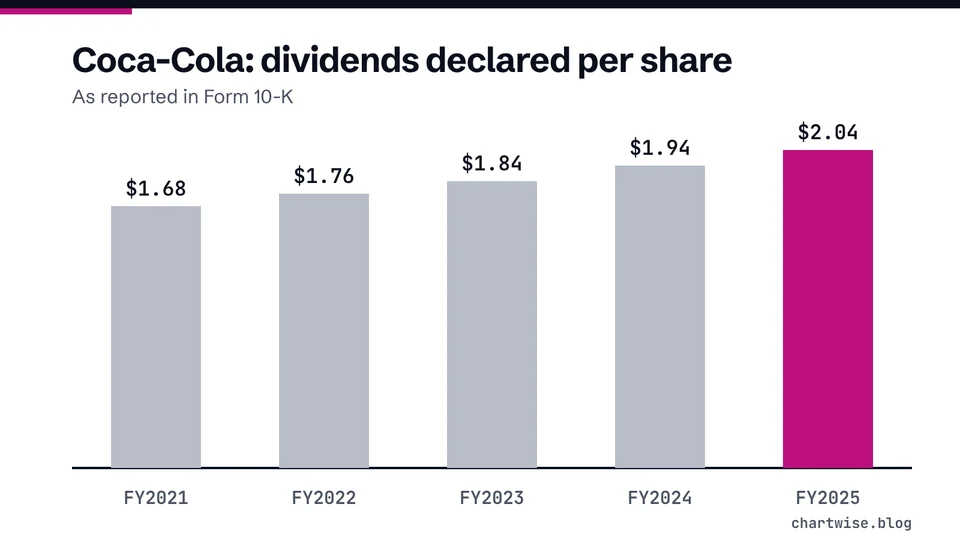
Coca-Cola shows how far apart the two can be. Its dividends paid per share for 2025 were $2.04, as reported in its Form 10-K for 2025. In February 2026 its board raised the quarterly dividend to 53 cents [4], and four payments of 53 cents add up to $2.12 (calculated). That assumes the rate holds for the whole year, which is not certain.
Why does the dividend yield go up when the price falls?#
The dividend sits on top of the fraction and the price sits underneath. If the dividend stays the same and the price drops, the yield rises. FINRA states it directly: typically, when a security's price rises, its yield falls; when its price falls, its yield rises [1]. Yield also changes when a company raises or lowers its dividend [1].
The yields below are for the same hypothetical stock paying $2.00 a year, at four different prices (calculated):
| Share price | Yearly dividend | Dividend yield |
|---|---|---|
| Price $80.00 | $2.00 | 2.5% |
| Price $50.00 | $2.00 | 4% |
| Price $40.00 | $2.00 | 5% |
| Price $25.00 | $2.00 | 8% |
Hypothetical stock, calculated. Nothing about the company's business changed between rows; only the price did.
What is a dividend yield trap?#
A yield trap is a stock that looks attractive because of a high yield, where the yield is high mainly because the price has fallen, and the dividend itself may not last. S&P Dow Jones Indices research notes that a high dividend yield may simply be the result of a decline in the company's stock price, all else equal, and that a company paying too much in dividends may find its dividend at higher risk of cancellation [5].
If the company then cuts its dividend, which it is allowed to do [3], the high yield you saw disappears. That is why it helps to check how much of its earnings a company pays out, which our page on the payout ratio explains.
Is a higher dividend yield better?#
Not on its own. FINRA explains that dividend yield is added to capital gains (or losses) to determine the total return of a stock or fund [1]. A stock can pay a generous dividend while its price falls by more than the dividend.
Suppose you bought the hypothetical stock at $50.00, received $2.00 in dividends over a year, and the price ended the year at $40.00. Your total return for the year is -16% (calculated): ($40.00 - $50.00 + $2.00) / $50.00. The 4% yield you started with did not protect you. The glossary entry on total return explains the measure in more detail, and every stock carries the risks covered in stock market risk explained.
Mistakes beginners make with dividend yield#
- Sorting by highest yield
A list ranked by yield can put falling stocks at the top, because a lower price raises the yield [1].
- Treating yield as a fixed rate
Unlike interest on a bond or a CD, stock dividends can be reduced or eliminated in lean periods [6].
- Ignoring the price
Total return includes price gains or losses [1]. A 4% yield does not offset a 20% fall in the price.
- Not checking which dividend was used
A yield based on last year's payments and one based on the latest rate can differ, as the Coca-Cola example above shows.
Frequently asked questions#
What is a good dividend yield?
There is no official figure. A yield is only meaningful next to the company's ability to keep paying, which the payout ratio helps you judge, and next to the price trend. A high yield may simply reflect a falling price [5].
Does dividend yield change every day?
Yes, whenever the price moves, because the price is the bottom of the fraction. It also changes when the company raises or lowers its dividend [1].
Is dividend yield the same as my return?
No. Total return adds the dividend yield to the capital gain or loss on the shares [1].
What is the dividend yield of a stock that pays no dividend?
Zero, because there is no dividend to divide. Not all stocks and funds pay dividends [1].
The bottom line#
Dividend yield is one division: the yearly dividend over the current price. Use it to compare income, but read it next to the price trend, the payout ratio and the total return, because a yield rises when the price falls and disappears when a dividend is cut. Try your own numbers in the dividend yield calculator, and remember that dividends are never certain and any stock can lose value.
Sources
- Defining the Value of an Investment.
- Evaluating Performance.
- Stocks.
- Board of Directors of The Coca-Cola Company Elects New Officer and Approves 64th Consecutive Annual Dividend Increase.
- S&P DJI's Dividend Indices: The Importance of Incorporating Quality Screens.
- Stocks | New York Attorney General.
Education only. This page is not investment, tax or legal advice. Stocks can lose value. See our risk disclosure.