Explainer · Dividends & Income
The dividend payout ratio explained
The payout ratio shows how much of a company's earnings it pays out as dividends. It is one of the simplest ways to see whether a dividend is small, large or larger than what the company earned.
Quick answer
The dividend payout ratio is the company's dividends divided by its earnings for the same period [1]. Per share, it is dividends per share divided by earnings per share. A company paying $2.00 on earnings of $2.50 per share has a payout ratio of 80% (calculated).
Key points
- Payout ratio = cash dividends / earnings for the same reporting period [1].
- Earnings per share shows what holders would get if all net income were paid out [2]; the payout ratio shows how much actually was.
- Above 100% means the company paid more in dividends than it earned that year (calculated from the formula).
- Earnings can fall while dividends rise, which pushes the ratio up, as Chevron's 2023 to 2025 figures show (calculated).
- A dividend can be cut at any time, whatever the ratio [6].
On this page
What is the dividend payout ratio?#
Nasdaq's glossary defines the payout ratio as the proportion of earnings paid out to common stockholders as dividends; more specifically, the firm's cash dividend divided by its earnings in the same reporting period [1].
It helps to start from earnings per share (EPS). The SEC explains that EPS tells you how much money shareholders would receive for each share if the company distributed all of its net income for the period [2]. The payout ratio then asks: of that amount, how much did the company actually distribute? What it does not pay out, it keeps. The SEC's guide describes dividends as earnings a company distributes instead of retaining them [2]. Our explainer on earnings per share covers how EPS itself is built.
payout ratio = (dividends per share / earnings per share) × 100
How do you calculate the payout ratio?#
- Get earnings per share for one period
FINRA explains that basic EPS is net income divided by outstanding common shares, and diluted EPS also counts shares that could be created from options, warrants and convertible securities [3].
- Get dividends per share for the same period
The two figures must cover the same reporting period [1]. We take both from the company's Form 10-K.
- Divide and multiply by 100
A hypothetical company with EPS of $2.50 and dividends of $2.00 per share has a payout ratio of 80% (calculated).
- Look at several years
One year can mislead. Compare the ratio over three or more years and see whether earnings or dividends drove the change.
- Earnings per share
- $2.50hypothetical example
- Dividends per share
- $2.00hypothetical example
- Payout ratio
- 80%$2.00 / $2.50, calculated
- Kept per share
- $0.50$2.50 - $2.00, calculated
What do real payout ratios look like?#
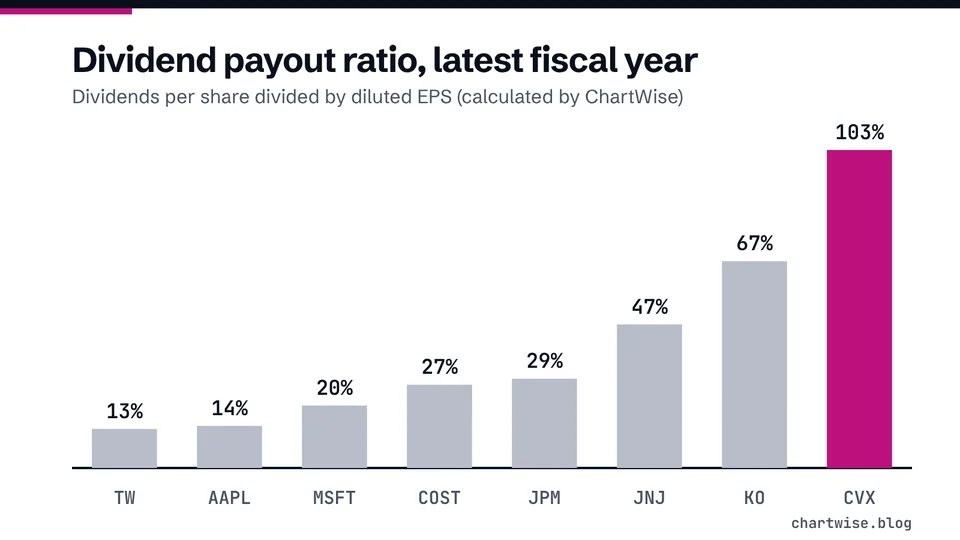
The table uses dividends per share and diluted earnings per share as each company reported them in its most recent Form 10-K. Coca-Cola reports dividends paid per share; Microsoft and Chevron report dividends declared per share. The ratios are our own arithmetic, not figures the companies publish, and they are not a judgement on any of the three stocks.
| Company and year | Dividends/share | Diluted EPS | Payout ratio |
|---|---|---|---|
| Coca-Cola, 2025 | $2.04 | $3.04 | 67.11% |
| Microsoft, fiscal 2026 | $3.64 | $17.95 | 20.28% |
| Chevron, 2025 | $6.84 | $6.63 | 103.17% |
Per-share figures as reported in each company's Form 10-K (SEC data). Microsoft's fiscal 2026 ended June 30, 2026. Payout ratios calculated. Microsoft's $3.64 matches the four quarterly dividends of $0.91 declared in fiscal 2026 [4].
How can a payout ratio go above 100%?#
Earnings and dividends do not have to move together. Chevron's own figures show it. Between 2023 and 2025 its diluted EPS fell 41.64% while its dividends declared per share rose 13.25% (both calculated from its 10-K figures), so the payout ratio climbed from 53.17% to 103.17% (calculated).
Paying out more than one year's earnings can be legally possible. Under Delaware corporation law, for example, directors may pay dividends out of the company's surplus, or, if there is none, out of net profits for the current and/or the previous fiscal year [5]. A ratio above 100% still means the dividend was not covered by that year's earnings.
Why does a high payout ratio matter?#
Because the dividend has to be paid from somewhere, and the board can change it. FINRA notes that a company can cut the amount of its dividend or eliminate it altogether [6]. S&P Dow Jones Indices research argues that a company paying too much in dividends may be left with little in reserve when markets turn, so its dividend may be at higher risk of cancellation [7].
Regulators have linked dividends to earnings directly. In June 2020 the Federal Reserve barred large banks from buying back shares in the third quarter, capped their dividends at the second-quarter amount, and limited them further to an amount based on recent earnings [8]. That was a rule for banks during the pandemic, not for all companies, but it shows a regulator tying dividends directly to recent earnings.
Is a low payout ratio always better?#
Not automatically. A low ratio means the company kept most of its earnings, as Microsoft did in fiscal 2026 at 20.28% (calculated). The SEC describes shareholders' equity as what owners invested plus or minus the company's earnings or losses since inception [2]. The payout ratio cannot tell you whether the company will use the earnings it keeps well.
The ratio also depends on the quality of the earnings figure. A one-off gain can make EPS high and the payout ratio low for a year; a one-off charge can do the reverse. That is why the steps above suggest looking at several years and reading the income statement behind the EPS. The ratio pairs naturally with dividend yield: yield tells you what you are paid relative to the price, and the payout ratio tells you how much of the earnings that payment uses.
Mistakes beginners make with the payout ratio#
- Mixing periods
Dividends and earnings must cover the same reporting period [1]. A quarterly dividend over annual EPS gives about a quarter of the true ratio when the four payments are equal.
- Judging from one year
Chevron's ratio moved from 53.17% to 103.17% in two years (calculated). A single year hides the trend.
- Ignoring what moved
A rising ratio can come from a higher dividend or from lower earnings. Check both lines before drawing a conclusion.
- Treating a low ratio as a promise
Even a well-covered dividend can be cut or eliminated by the board [6].
Frequently asked questions#
What is a good payout ratio?
There is no official figure. The sources we cite define the ratio but do not set a safe level [1]. Compare a company's ratio across several years and with its earnings trend.
Can the payout ratio be negative?
Yes, arithmetically. If a company reports a loss (negative EPS) and still pays a dividend, dividing by a negative number gives a negative ratio. In that case the dividend was paid in a year with no earnings at all.
Should I use basic or diluted EPS?
Either, as long as you say which and use the same one every year. Diluted EPS also counts shares that could be created from options, warrants and convertibles [3]. The table on this page uses diluted EPS.
The bottom line#
The payout ratio is dividends divided by earnings for the same period. It shows how much of the profit a company hands back and how much it keeps, and a reading above 100% means that year's dividend was not covered by that year's earnings. Use it over several years, next to the dividend yield and the earnings trend, and remember that no ratio makes a dividend certain. The dividend yield calculator also works out a payout ratio if you enter earnings per share.
Sources
- Payout ratio.
- Beginners' Guide to Financial Statements.
- Financial Performance Metrics Every Investor Should Know.
- Dividends Declared (Detail) (Microsoft Form 10-K, fiscal year ended June 30, 2026, R98).
- Title 8, Chapter 1, Subchapter V. Stock and Dividends.
- Stocks.
- S&P DJI's Dividend Indices: The Importance of Incorporating Quality Screens.
- Federal Reserve Board releases results of stress tests for 2020 and additional sensitivity analyses conducted in light of the coronavirus event.
- Defining the Value of an Investment.
Education only. This page is not investment, tax or legal advice. Stocks can lose value. See our risk disclosure.