Explainer · Reading a Stock Page
The bid-ask spread on a stock page
Many stock pages show two prices next to the last trade: the bid and the ask. The gap between them is the bid-ask spread, and it is a cost you pay whenever you buy and later sell.
Quick answer
The bid is the highest price a buyer will pay, the ask is the lowest price a seller will accept, and the spread is the difference [1]. You usually buy near the ask and sell near the bid, so a wide spread raises your cost [2].
Key points
- Spread = ask minus bid. The SEC's investor site defines it exactly that way [1].
- Large spreads can reduce returns by raising the price you buy at or lowering the price you sell at [2].
- Stocks with lower trading volume tend to be less liquid, and illiquid investments often have wide spreads [2].
- Outside regular hours, spreads may be wider than normal [5].
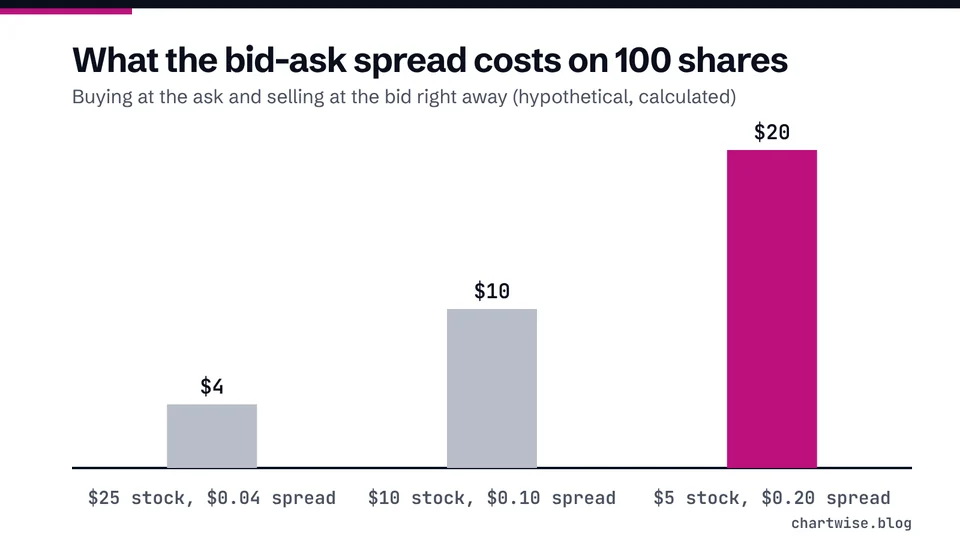
- Compare the spread with the price: $0.04 on a $25 stock is 0.16% of the midpoint, while $0.20 on a $5 stock is 4% (calculated).
On this page
What are the bid, the ask and the spread?#
A stock quote is not one price. It is a meeting point between people who want to buy and people who want to sell. The SEC's investor education site, Investor.gov, defines the bid as the highest price a buyer will pay for a specified number of shares at any given time, and the ask as the lowest price at which a seller will sell [1]. The bid is almost always lower than the ask, and the difference between them is called the spread [1].
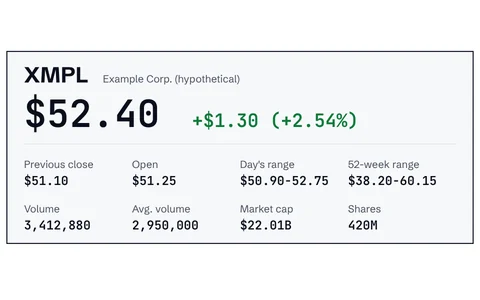
Many stock pages show the last price in large type, and some add a smaller line such as "Bid 24.98 x 300, Ask 25.02 x 500". The first number in each pair is the price. The number after the "x" is often the size waiting at that price, though each site labels it in its own way, so check the page's notes. Our guide on how to read a stock quote walks through every field on that line.
Here is how three hypothetical quotes compare. "Spread %" is the spread divided by the midpoint between bid and ask, which lets you compare stocks at very different prices. "Cost, 100 shares" is what you would lose by buying 100 shares and selling them straight back.
| Hypothetical stock | Bid | Ask | Spread | Spread % | Cost, 100 shares |
|---|---|---|---|---|---|
| Busy $25 stock | $24.98 | $25.02 | $0.04 | 0.16% | $4.00 |
| Quieter $10 stock | $9.95 | $10.05 | $0.10 | 1% | $10.00 |
| Thinly traded $5 stock | $4.90 | $5.10 | $0.20 | 4% | $20.00 |
Illustrative quotes for hypothetical companies, not real prices. The last column assumes you buy at the ask and sell at the bid while the quote stays the same. All figures calculated.
Why is the spread a cost when you trade?#
Because a buyer who wants shares right now has to meet a seller's price, and a seller who wants out right now has to meet a buyer's price. FINRA puts the effect in one line: large bid-ask spreads can reduce returns by increasing the buy price or lowering the sell price [2].
The SEC's bulletin on order types adds a related warning. A market order is an order to buy or sell at the best available price, and it generally executes immediately, but its price is not guaranteed [3]. The last-traded price shown in big type is not necessarily the price your market order will get [3]. That is why the bid and ask matter more than the last price at the moment you trade.
- Spread per share
- $0.04$25.02 minus $24.98, calculated
- Midpoint
- $25.00average of bid and ask, calculated
- Spread as % of midpoint
- 0.16%$0.04 / $25.00, calculated
- Cost of one round trip, 100 shares
- $4.00$0.04 x 100, calculated
Why are some spreads wide and others narrow?#
Liquidity plays a big part. FINRA describes liquidity as being able to buy and sell quickly without significantly affecting prices [4]. It also says securities with higher trading volume are generally more liquid, that large-cap stocks are usually more liquid than small- or micro-cap stocks, and that illiquid investments often have a wide bid-ask spread [2]. Our page on volume and average volume shows where to find those numbers on a quote.
Time of day matters too. FINRA Rule 2265 requires brokers to warn customers that lower liquidity and higher volatility in extended hours trading may result in wider than normal spreads [5]. The SEC's extended-hours bulletin says reduced trading interest generally results in wider spreads or no quotes at all [6]. More on that in our guide to pre-market and after-hours trading.
How small can a spread get?#
There is a floor set by the SEC's minimum pricing increment rule, Rule 612. The rule text shown on the government's eCFR site in October 2026 sets a $0.01 increment for a stock priced at $1.00 or more, or $0.005 if its time-weighted average quoted spread during a three-month evaluation period was $0.015 or less; stocks priced below $1.00 can be quoted in steps as small as $0.0001 [7]. The $0.005 option comes from a 2024 amendment, and in June 2026 the SEC extended relief from complying with the amended rule until the first business day of November 2027 [8]. So do not assume a stock is quoted in half-pennies without checking the current status.
Either way, the gap between the bid and the ask cannot be smaller than the increment the stock is quoted in [7]. Nothing in the rule stops a quiet stock's spread from being many times wider, as the hypothetical table above shows.
How do you check the spread before you trade?#
- Find the live bid and ask
Look on your broker's order screen, not only on a chart. A delayed quote can show bid and ask prices 15 or sometimes 20 minutes after the fact [9].
- Subtract the bid from the ask
That is the spread per share [1]. Multiply by the number of shares to see it in dollars.
- Turn it into a percentage
Divide the spread by the midpoint. This lets you compare a $5 stock with a $500 stock. In the percentage change calculator, entering the bid as the start and the ask as the end gives the gap as a percentage of the bid.
- Decide on the order type
A limit order lets you set the most you will pay or the least you will accept, but it is not guaranteed to execute [3].
- Check again just before sending
Quotes change through the day, and outside regular hours spreads may be wider than normal [5].
Does the spread matter for long-term investors?#
Less than for frequent traders, but it never disappears. If you buy once and hold for years, a $0.04 spread on a $25 stock is a one-time cost of 0.16% of the midpoint (calculated). If you trade the same stock in and out 20 times, you pay that gap 20 times. On a thinly traded $5 stock with a $0.20 spread, a single round trip of 100 shares costs $20.00, which is 4% of the midpoint price (calculated).
The spread is also a signal. A very wide gap can be a sign that few people are trading the stock at that moment, and FINRA notes that if you need to sell an illiquid security quickly you might have to accept a lower price, and in some cases might not be able to sell at all [2].
Mistakes beginners make with the bid-ask spread#
- Reading only the last price
The big number is the last trade. A market order may fill at a different price, and the SEC says the last-traded price is not necessarily the execution price [3].
- Using market orders on thinly traded stocks
When few shares sit at the bid or ask, a market order can reach deeper into worse prices. Parts of a large market order may execute at different prices [3].
- Comparing spreads in dollars only
A $0.10 spread is tiny on a $500 stock and large on a $2 stock. Always convert it into a percentage of the price.
- Trading right after the close
Spreads may be wider than normal in extended hours [5]. If there is no reason to trade then, waiting for regular hours is an option.
- Thinking zero commission means zero cost
You still buy near the ask and sell near the bid. See brokerage fees and costs for the other charges to look for.
Frequently asked questions#
Is the bid always lower than the ask?
Almost always. Investor.gov notes the bid price is almost always lower than the ask, or offer, price [1]. If a buyer were willing to pay the seller's price, the two orders would normally trade with each other.
What is a good bid-ask spread for a stock?
There is no official cut-off. FINRA says illiquid investments often have a wide bid-ask spread and that higher-volume securities are generally more liquid [2]. Compare the spread as a percentage of the price, and compare it with the stock's usual volume.
Why does the spread get wider after the market closes?
Fewer people trade. FINRA's required risk disclosure says lower liquidity and higher volatility in extended hours may result in wider than normal spreads [5].
Do I pay the spread if I use a limit order?
A limit order lets you choose your price, so you may get a better price than the ask when buying, but it is not guaranteed to execute [3]. If you set your limit at the ask, you pay the spread like a market order would.
The bottom line#
Before any trade, look past the big last-price number to the bid and the ask. Subtract one from the other, turn the gap into a percentage of the price, and think about how many times you will pay it. A wide spread is a cost and often a sign that few people are trading. For the full quote line, read how to read a stock quote, and read our risk disclosure before you trade.
Sources
- Bid Price.
- Understanding Market Liquidity and Your Investments.
- Understanding Order Types | Investor.gov.
- Key Terms for Tough Times: The Vocabulary of Stressed Markets.
- 2265. Extended Hours Trading Risk Disclosure | FINRA.org.
- Extended-Hours Trading: Investor Bulletin.
- 17 CFR 242.612 -- Minimum pricing increment.
- Order Granting Temporary Exemptive Relief, Pursuant to Section 36(a)(1) of the Securities Exchange Act of 1934 and Rules 610(f) and 612(d) of Regulation NMS, from Compliance with Rule 600(b)(89)(i)(F), Rule 610(c) and Rule 612 of Regulation NMS, as Amended (Release No. 34-105656).
- Real time Definition.
Education only. This page is not investment, tax or legal advice. Stocks can lose value. See our risk disclosure.