Glossary
Revenue
Revenue tells you how much a company sold. It does not tell you how much the company kept, and beginners often mix the two up.
Revenue is the value of the goods and services a company sold during a period, before any costs are subtracted. It is the first line of the income statement, which is why people call it the top line.
Quick answer
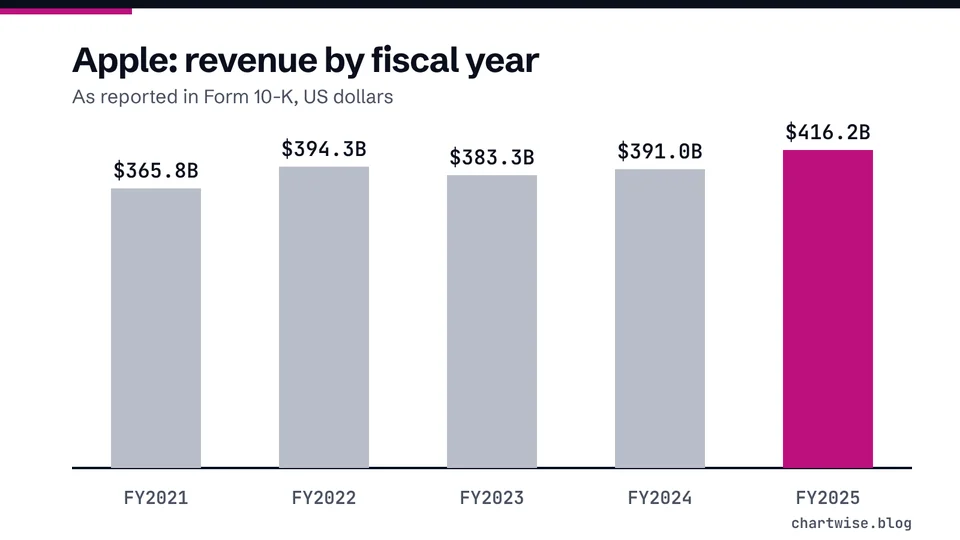
Revenue is the money a company brings in from selling its products or services over a period, such as a fiscal year. The SEC calls it the top line of the income statement [1]. Costs, interest and taxes are subtracted later to reach net income [4].
Key points
- Revenue (also called sales) is the top line of the income statement; net income is the bottom line [1].
- Under U.S. accounting rules, revenue is recorded when (or as) the company delivers the goods or services it promised [5].
- High revenue does not mean high profit: two companies can sell very different amounts and keep very different shares of each dollar.
On this page
What does revenue mean on an income statement?#
The SEC's beginner guide describes the top of the income statement as the total money brought in from sales of products or services, often called gross revenues or sales. Subtract returns and allowances and you get net revenues [1]. The SEC rule that lists income statement line items, Regulation S-X Rule 5-03, likewise starts with net sales, defined as gross sales less discounts, returns and allowances, and asks companies to show product sales, service revenues and other revenues separately [2].
The accounting standard setter, the FASB, defines revenues as inflows of assets (or settled liabilities) from delivering or producing goods, rendering services or carrying out other activities [3]. In plain words: what customers paid, or owe, for what the company handed over. Different filings label the line differently: "net sales", "revenues" or "total net revenue" all point to the same idea. You can see the full sequence of lines in how to read an income statement.
When does a company count a sale as revenue?#
The FASB's revenue standard, Topic 606, applies to all entities that report under U.S. GAAP [5]. Its core principle is that a company recognizes revenue to depict the transfer of promised goods or services to customers, in the amount it expects to be entitled to in exchange [5]. The standard lays out five steps: identify the contract with the customer, identify the promises in it, set the price, split the price across the promises, and recognize revenue when (or as) each promise is satisfied [5].
The test is delivery of what was promised. A sale on the income statement is therefore an accounting measure of what the company delivered in the period, which can differ from the cash it collected in the same period. The cash flow statement is where you see the cash [1].
Why is revenue not the same as profit?#
Revenue is before every cost. Net income is what is left after all expenses and taxes have been deducted from revenue [4]. Two real companies show how far apart the two numbers can be. The figures below are total revenue and net income as reported in each company's Form 10-K.
| Company and fiscal year | Revenue | Net income | Net income per $100 of revenue |
|---|---|---|---|
| Costco, fiscal 2025 (ended Aug 31, 2025) | $275.235 billion | $8.099 billion | $2.94 |
| Coca-Cola, fiscal 2025 (ended Dec 31, 2025) | $47.941 billion | $13.107 billion | $27.34 |
Revenue and net income from each company's Form 10-K (SEC XBRL data). Last column calculated. See the Costco and Coca-Cola pages.
Costco's revenue was about 5.74 times Coca-Cola's (calculated), yet Coca-Cola reported the larger net income. Retailers and brand owners run very different businesses, which is why ratios are best compared within an industry [6]. The share of revenue a company keeps is its profit margin, covered in return on equity and profit margins explained.
Frequently asked questions#
Is revenue the same as sales?
What is the difference between gross revenue and net revenue?
Can revenue grow while the company loses money?
Yes. Revenue is measured before costs, so if costs, interest or taxes grow faster than sales, net income can shrink or turn into a loss even while revenue rises [4].
The bottom line#
Read revenue as the size of the business in a period, not as its profit. Check whether the figure is net of returns and discounts, compare it with the same period a year earlier, and then follow it down the income statement to net income to see how much of each dollar the company kept.
Sources
- Beginners' Guide to Financial Statements.
- 17 CFR 210.5-03 Statements of comprehensive income.
- Statement of Financial Accounting Concepts No. 8, Conceptual Framework for Financial Reporting, Chapter 4, Elements of Financial Statements.
- Net Income.
- Revenue from Contracts with Customers (Topic 606), Accounting Standards Update No. 2014-09, Section A.
- Evaluating Stocks.
Education only. This page is not investment, tax or legal advice. Stocks can lose value. See our risk disclosure.