Glossary
Share buyback: when a company buys its own stock
Buybacks are one way, alongside dividends, that a company hands cash back to its owners. They change the share count, the per-share numbers you read on a stock page, and since 2023 they carry a small federal tax.
A share buyback, or stock repurchase, is a purchase of a company's own shares made by or on behalf of the company [1]. Like a dividend, it distributes resources to shareholders [2], but by reducing the number of shares outstanding rather than paying everyone cash.
Quick answer
A share buyback is when a company buys its own shares. It returns cash to shareholders who sell and leaves fewer shares, so the same profit is spread across fewer shares. Public U.S. companies pay a 1% excise tax on repurchases made after 2022 [9].
Key points
- Buybacks, like dividends, distribute resources to shareholders [2]; they do it by shrinking the share count.
- Companies report repurchases in a monthly table: shares bought, average price paid, and how much of an announced program may still be bought [1].
- Since 2023, a 1% excise tax applies to the fair market value of stock repurchased by covered U.S. public companies [9].
On this page
What is a share buyback?#
It is a company spending its own money to purchase its own shares. SEC disclosure rules cover any purchase made by or on behalf of the issuer, or an affiliated purchaser, of its registered equity securities [1]. A Federal Reserve note describes buybacks and dividends as two ways of distributing resources to shareholders [2], and a 2003 speech by Federal Reserve Governor Ben Bernanke described a share as a claim on current and future dividends or other cash flows, such as stock buybacks [3].
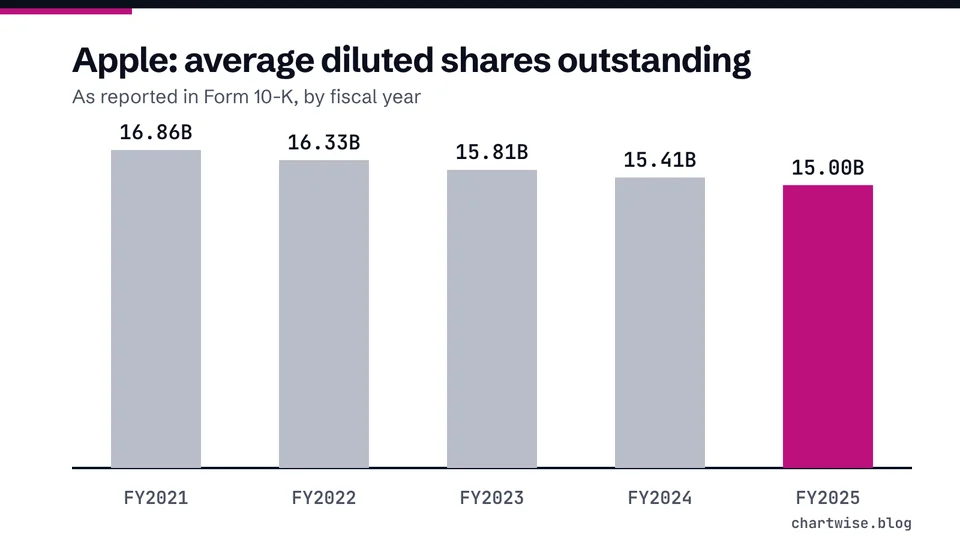
Companies may announce a program first. Apple, for example, announced on May 1, 2025 an additional program to repurchase up to $100 billion of its common stock [4]. "Up to" matters: an announcement is a capacity, not a promise to spend it all.
When a company does buy, it has to show it. Under Item 703 of Regulation S-K, the company gives a table for each month of the period covering the total number of shares purchased, the average price paid per share, the shares bought under publicly announced programs, and the maximum number or approximate dollar value that may yet be purchased [1]. Companies can also choose to follow an SEC safe harbor, Rule 10b-18: one of its conditions is that purchases on any single day must not exceed 25 percent of the stock's average daily trading volume [5].
| Column in the monthly table | What it tells you |
|---|---|
| Total number of shares purchased | How many shares the company actually bought that month |
| Average price paid per share | What it paid on average, to compare with today's price |
| Shares bought under announced programs | How much of the buying was part of a public program |
| Maximum that may yet be purchased | How much room is left in the program, in shares or dollars |
Columns required by Item 703 of Regulation S-K [1].
How does a buyback change earnings per share?#
Earnings per share tells you how much shareholders would receive for each share if the company paid out all of its net income for the period [6]. Fewer shares means the same profit is divided by a smaller number, so EPS rises even if the business earns exactly the same. That is arithmetic, not growth, which is why it helps to compare EPS growth with net income growth. Our explainer on earnings per share shows where to find both in a filing.
- Net income (unchanged)
- $10,000,000hypothetical input, used in the calculated rows below
- EPS with 100 million shares
- $0.10calculated
- EPS after buying back 5 million shares
- $0.1053$10,000,000 / 95,000,000, calculated
- Change in EPS
- +5.26%calculated; ignores the interest the spent cash could have earned
Are share buybacks good or bad for shareholders?#
It depends on the price paid and what else the money could have done, and economists still debate the wider effects. One concern is that companies cut investment to fund buybacks and dividends. A 2017 Federal Reserve note examined that possibility across economies and found little evidence that economies with bigger shortfalls in corporate investment had bigger increases in buybacks, while saying more analysis is needed [2].
There is also a tax cost. The Inflation Reduction Act of 2022 created an excise tax equal to 1% of the fair market value of stock repurchased during the tax year by certain publicly traded corporations, for repurchases after 2022 [9]. It applies to domestic corporations whose stock trades on an established securities market [9]. On $1 billion of buybacks, 1% is $10 million (calculated), before any adjustments the IRS form allows.
For you as a shareholder, a buyback is not a guarantee of anything. The company may pay more than the shares later trade for, and a rising EPS from a shrinking share count can hide flat profits. Compare it with a stock split, which changes the share count without any cash changing hands, and read how buybacks show up in an earnings report.
Frequently asked questions#
Is a share buyback the same as a dividend?
No, though both distribute resources to shareholders [2]. A dividend pays cash to every holder. A buyback pays only the holders who sell, and leaves everyone else owning a slightly larger share of a company with fewer shares.
Does an announced buyback program have to be completed?
Where can I see how much stock a company bought back?
Is there a tax on stock buybacks?
Yes, for the company. A 1% excise tax applies to the fair market value of stock repurchased by covered U.S. public corporations, for repurchases after 2022 [9].
The bottom line#
A buyback turns company cash into a smaller share count. Read the monthly repurchase table to see what was actually bought and at what price, compare EPS growth with net income growth, and remember the 1% excise tax and the money that was not invested elsewhere. A buyback is a capital decision by management, not a signal for you to buy or sell. See our risk disclosure before acting on any company news.
Sources
- 17 CFR 229.703 (Item 703) Purchases of equity securities by the issuer and affiliated purchasers.
- Corporate Buybacks and Capital Investment: An International Perspective.
- Remarks by Governor Ben S. Bernanke: Monetary Policy and the Stock Market: Some Empirical Results.
- Apple Inc. Form 10-K for the fiscal year ended September 27, 2025.
- 17 CFR 240.10b-18 Purchases of certain equity securities by the issuer and others.
- Beginners' Guide to Financial Statements.
- Apple Inc. Form 10-K for the fiscal year ended September 26, 2020.
- Earnings Per Share (Apple Inc. Form 10-K for the fiscal year ended September 27, 2025, R11).
- Instructions for Form 7208 (12/2025).
- Using EDGAR to Research Investments.
Education only. This page is not investment, tax or legal advice. Stocks can lose value. See our risk disclosure.