Glossary
Stock split: more shares, same total value
A split changes how many slices the pie is cut into, not the size of the pie. A reverse split does the opposite, and it deserves more caution.
A stock split is a decision by a company's board to increase the number of its outstanding shares by issuing new shares to existing shareholders in a set proportion [2]. The price per share falls in proportion, so the total value of your holding is the same right after the split [2].
Quick answer
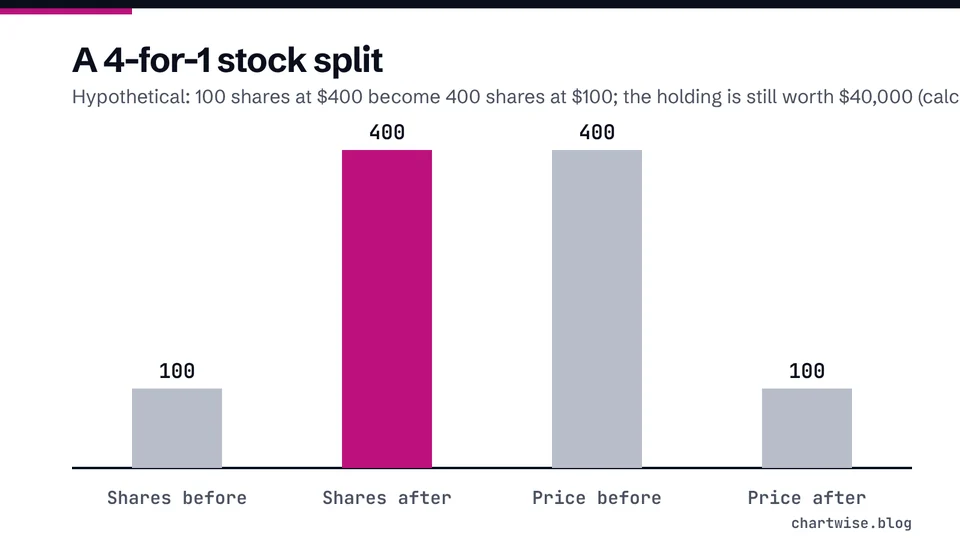
A stock split increases a company's share count and lowers the price per share in the same proportion. In a two-for-one split, 100 shares at $100 become 200 shares at $50 [1]. Your total value and your ownership stake do not change [2] [1].
Key points
- A split adds shares without changing shareholders' equity or the total value of your holding [1] [2].
- Common ratios are 2-for-1, 3-for-2 and 3-for-1 [2]; a reverse split, such as 1-for-10, cuts the share count instead [4].
- FINRA advises caution with reverse splits, which tend to go hand in hand with low-priced, high-risk stocks [2].
On this page
What happens to your shares in a stock split?#
You get more shares, each worth less, and the total stays the same. The SEC's investor site gives the classic example: if you own 100 shares at $100 and the company does a two-for-one split, you own 200 shares at $50 immediately afterwards [1]. FINRA puts it simply: you have more shares than you started with, but their total value is the same as before the split [2].
Your slice of the company does not change either. A stock split does not dilute the ownership interests of existing shareholders [1], because every holder gets new shares in the same proportion. The company's market cap, price times shares, is unchanged by the split itself.
The most common ratios are 2-for-1, 3-for-2 and 3-for-1 [2]. Here is what each does to the same starting position of 150 shares at $90, worth $13,500.
| Split ratio | Shares after | Price after | Total value |
|---|---|---|---|
| Before any split | 150 | $90.00 | $13,500 |
| 2-for-1 split | 300 | $45.00 | $13,500 |
| 3-for-2 split | 225 | $60.00 | $13,500 |
| 3-for-1 split | 450 | $30.00 | $13,500 |
Hypothetical position, all figures calculated. Ratios from [2].
Why do companies split their stock?#
The SEC's investor site says companies often split shares to make them more affordable to investors [1]. FINRA adds that one reason is a psychological barrier to trading high-priced shares [2]. Neither source says a split makes the company worth more, and it does not change the business.
One practical effect shows up in financial data. In the Apple example below, the company restated its earlier share and per-share figures for the split [3], so numbers in later reports can differ from the ones printed at the time. Our page on earnings per share explains why the share count matters.
What is a reverse stock split?#
A reverse split shrinks the share count. Each outstanding share is converted into a fraction of a share; in a 1-for-10 reverse split, every ten shares you own become one [4]. The SEC's investor site says companies may do this to increase the trading price of their shares, for example to regain compliance with an exchange's minimum bid price requirement [4]. FINRA names the same listing reason and adds appealing to institutions that avoid low-priced stocks [2].
If your share count does not divide evenly, small holders may be cashed out, receiving a proportionate amount of cash in lieu of the partial share [4].
Frequently asked questions#
Does a stock split make my shares worth more?
No. You get more shares at a lower price, and the total value is the same as before the split [2]. What happens to the price afterwards depends on the market, not on the split arithmetic.
Does a split change my ownership percentage?
No. A stock split does not dilute existing shareholders' ownership interests [1], because everyone receives new shares in the same proportion.
Is a reverse stock split a bad sign?
Not automatically, but FINRA advises caution: reverse splits tend to go hand in hand with low-priced, high-risk stocks [2]. Read the company's filings to see why it is doing one.
How is a split different from a share buyback?
A split changes the number of shares every holder owns in the same proportion. A share buyback is the company spending cash to buy its own shares, which reduces the share count without giving holders new shares.
The bottom line#
A stock split rearranges the same value into more, cheaper shares; a reverse split packs it into fewer, pricier ones. Neither changes what the company earns. Treat reverse splits with extra care, check the company's own filings for the reason, and read our risk disclosure before acting on any corporate event.
Sources
Education only. This page is not investment, tax or legal advice. Stocks can lose value. See our risk disclosure.